
Articles
Climate & Sustainability
The Green Overseas (GO) Programme and the Future of Climate-Resilient Islands
COP30 concluded a couple of weeks ago in Belém do Pará, leaving behind a clear message for the global community: islands are leading some of the most innovative responses to climate change, yet systemic barriers continue to block their access to the finance they urgently need.
For Overseas Countries and Territories (OCTs) and Sub-National Island Jurisdictions (SNIJs), this year's COP marked a turning point. Their challenges, innovations, and voices were amplified more strongly than ever before, thanks in part to the presence and leadership of the Green Overseas Programme, funded by the European Union and implemented by Expertise France.
Across multiple sessions, media features, and technical discussions, GO placed OCT realities at the centre of the climate agenda, reinforcing the organisation's mission to strengthen island resilience through improved governance, enhanced mobility planning, and stronger pathways to climate finance.
The 25 EU and UK Overseas Territories (…) are demonstrating some of the most innovative climate responses globally, yet remain systematically unable to access the funding to scale them.— Cayman iNews
Similar coverage appeared on the BBC World Service, Cayman Compass, St Martin News Network, Bonaire.nu, BES Reporter, Aruba.nu, and 721 News, marking one of the strongest waves of international attention ever directed at OCT climate issues.
Why OCTs and SNIJs Took Centre Stage
Island communities from the Caribbean to the South Pacific, from the North Atlantic to the Indian Ocean, face the most immediate climate pressures: erosion, water scarcity, high energy costs, and infrastructure exposed to storms and rising seas. Yet for OCTs and SNIJs, an added challenge persists. Their political status removes them from eligibility for major climate funds designed for developing nations.
This structural gap was clearly articulated by Ahab Downer, Green Overseas Programme Director, who noted that despite escalating needs, access to climate finance remains "grossly insufficient." OCTs may be linked to wealthy states, but their local administrations operate with limited budgets, modest revenue bases, and direct exposure to climate shocks.
GO's Leadership in Key COP30 Dialogues
The Green Overseas Programme contributed its expertise throughout the Island Voices @COP30 series, particularly in sessions on climate mobility, governance, youth leadership, and financing resilience.
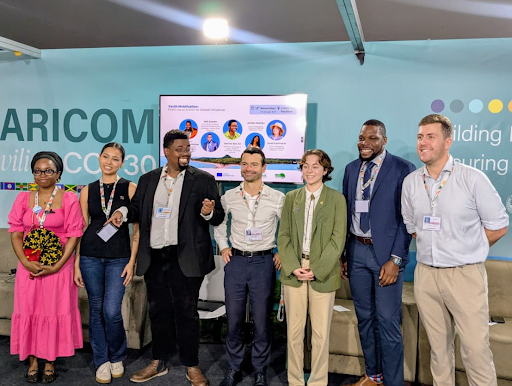
At the CARICOM Pavilion session "Youth Mobilisation: From Local Action to Global Influence," Expertise France CEO Jérémie Pellet highlighted the Caribbean's long-standing leadership in resilience. He stressed how the GO Programme is strengthening OCT capacities while amplifying youth and community voices across European and UK territories.
Young advocates from Curaçao, Mayotte, Anguilla, and the Cayman Islands shared their work on climate adaptation and justice, underscoring the need for intergenerational island resilience.
In the session "Resilient by Design: Island Solutions for Climate Mobility," Nicolas Chenet, Sustainability Director at Expertise France, presented GO's approach to proactive adaptation. Rather than treating mobility as a crisis response, he emphasised the need for forward-looking planning informed by traditional knowledge, scientific modelling, and inclusive governance.
Chenet underscored that technical innovation alone cannot secure resilience. Without strong local institutions, community participation, and long-term planning, adaptation risks repeating the top-down approaches that have historically failed many island communities.
Building Financial Pathways for Climate-Resilient Futures in Islands
At the session "Building Financial Pathways for Climate-Resilient Futures in Islands," Chenet addressed one of the most persistent barriers for islands: the lack of capacity to prepare projects to the level required by global funders. Many adaptation and renewable energy ideas in OCTs never move forward, not because of a lack of ambition, but due to the absence of feasibility studies, modelling, and regulatory assessments. GO's support directly addresses this gap.
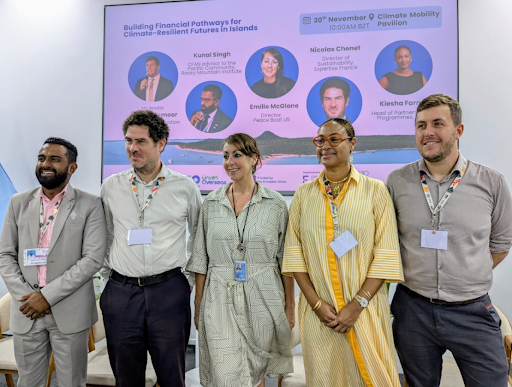
Building Financial Pathways for Climate-Resilient Futures in Islands
Chenet also highlighted new financial models gaining relevance for islands, including blended finance structures, revolving adaptation funds, and ecosystem endowments that create long-term funding streams for conservation and mobility-sensitive adaptation.
The GO Facilities and Communities: Turning Local Priorities Into Action
A cornerstone of GO's work is the GO Facilities, which allows each OCT to submit up to two tailored project proposals aligned with their resilience and energy-transition priorities. The Facility supports the full project cycle from technical design and modelling to regulatory alignment and capacity-building, all funded directly by the GO Programme.
COP30 offered an opportunity to spotlight ongoing Green Overseas Programme interventions across the OCTs. These projects reflect a strategy anchored in both urgency and long-term resilience:
- In Anguilla, GO developed climate-impact modelling and water security decision tools.
- In Sint Eustatius, GO funded an agrovoltaic pilot combining solar power, rainwater harvesting, and experimental crops.
- In Aruba, GO strengthened the regulatory framework to accelerate renewable energy investments.
- In Wallis and Futuna, GO supported eco-construction by promoting sustainable building techniques.
- In French Polynesia, GO contributed to a 30-year coastal evolution study launched in 2025, essential for adaptation planning.
The Programme also convenes "GO Communities," knowledge-exchange networks that connect OCTs facing similar challenges through hybrid workshops, e-learning, and best-practice collections that promote peer learning, reduce duplication, and allow innovative models to scale across regions.
This collaborative approach responds to three priorities:
- Addressing common OCT needs
- Producing added value at regional and interregional levels
- Generating immediate, applicable territorial impact
During COP30, this collaborative momentum was evident as territories compared strategies for climate mobility, water security, coastal management, and community-led adaptation.
A Turning Point for OCT Advocacy
COP30 demonstrated that OCTs are not passive participants in the climate agenda; they are innovators whose solutions carry lessons for island and coastal regions worldwide. As global climate negotiations move forward, one message from Belém remains clear: islands cannot build resilience without access to finance, and climate finance cannot succeed without recognising the realities of OCT and SNIJ.
With tools such as the GO Facilities and Communities, targeted technical support, regional collaboration, and strengthened governance, OCTs are designing their own pathways toward a climate-resilient future. Island Innovation will continue to champion this work and ensure the stories, contributions, and innovations of islands everywhere remain at the centre of the global climate conversation.