
The Virgin Islands Climate Change Trust Fund Sets Sail at GSIS 2026
A launch ten years in the making. What it means for the Virgin Islands, and for every island territory facing the same locked door.
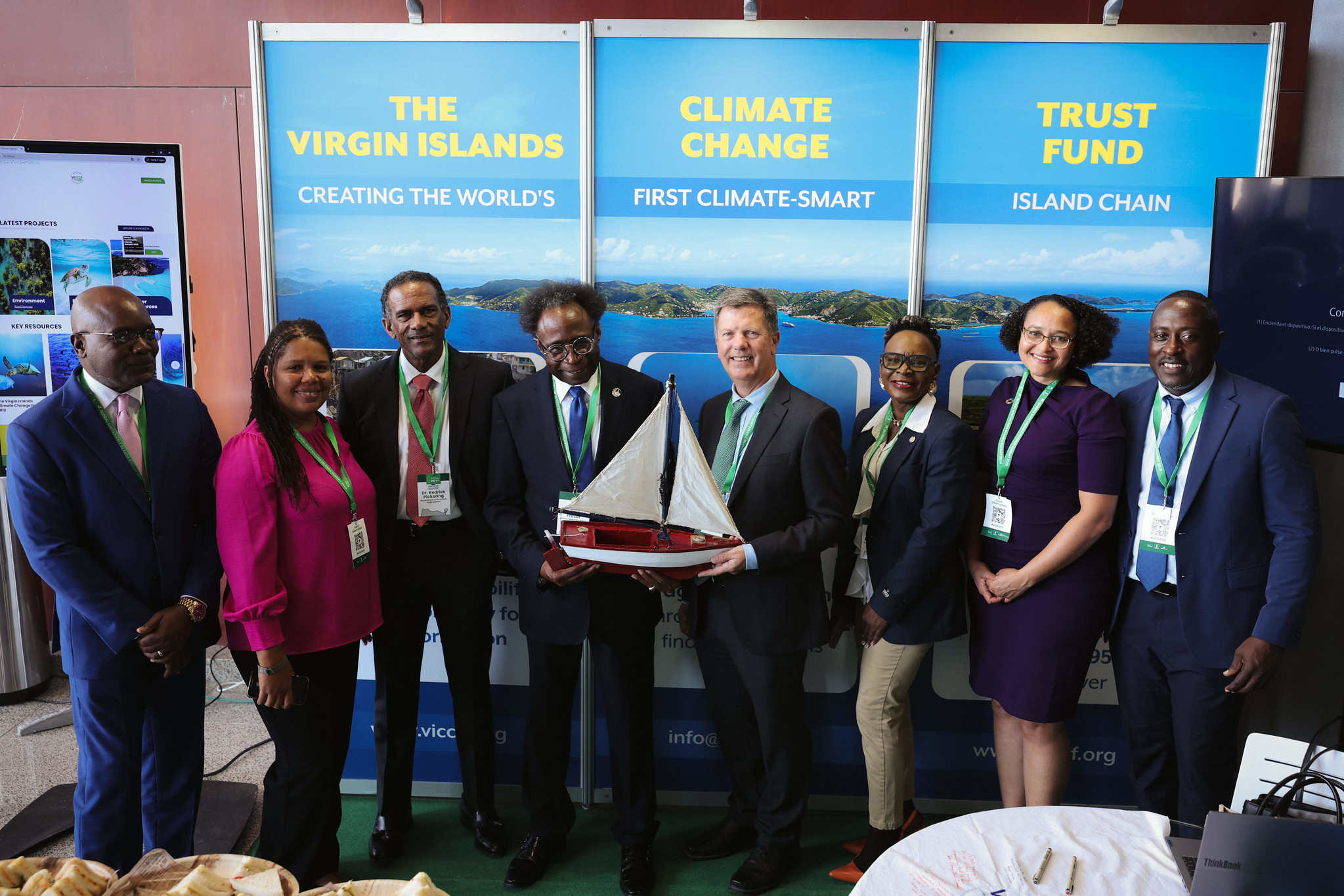
On 21 April 2026, the Virgin Islands Climate Change Trust Fund officially launched at the Global Sustainable Islands Summit in Gran Canaria. For those who had followed its development, the moment carried a specific weight. The Fund was legally established in 2015. A decade later, with governance structures in place, a CEO appointed, USD 5.5 million in seed funding secured through a local Environmental Levy, and first calls for proposals in preparation, it stepped into its operational phase before the international audience best positioned to help it scale.
This article picks up where Island Innovation's pre-event preview left off.
A Structural Problem That Predates the Fund
To understand why the VICCTF matters, it helps to be precise about the problem it was built to solve.
Small island territories and Overseas Territories sit in a contradictory position within the international climate finance system. They are among the jurisdictions most exposed to climate impacts: coastal erosion, extreme weather, water stress, and energy vulnerability. Yet their constitutional status places them outside the eligibility criteria of the major mechanisms designed to fund exactly this kind of resilience work. The Virgin Islands cannot access the Green Climate Fund, the Adaptation Fund, or the new Loss and Damage Fund. Historically, the Territory has received limited climate finance from the United Kingdom, mainly delivered through environment-focused programmes like Darwin. Domestic resources alone cannot meet the scale of investment required.
This is not only the Virgin Islands' problem. It is a systemic problem. Dozens of island territories across the Caribbean, the Pacific and the Indian Ocean face identical constraints. The architecture of international climate finance was built around sovereign states, and sub-national island jurisdictions were not part of the design.
Deputy Premier Fraser described the consequence at the launch without abstraction: "For years, a major finance gap has stood between The Virgin Islands devastated by Hurricane Irma and the vision for our climate-resilient future."
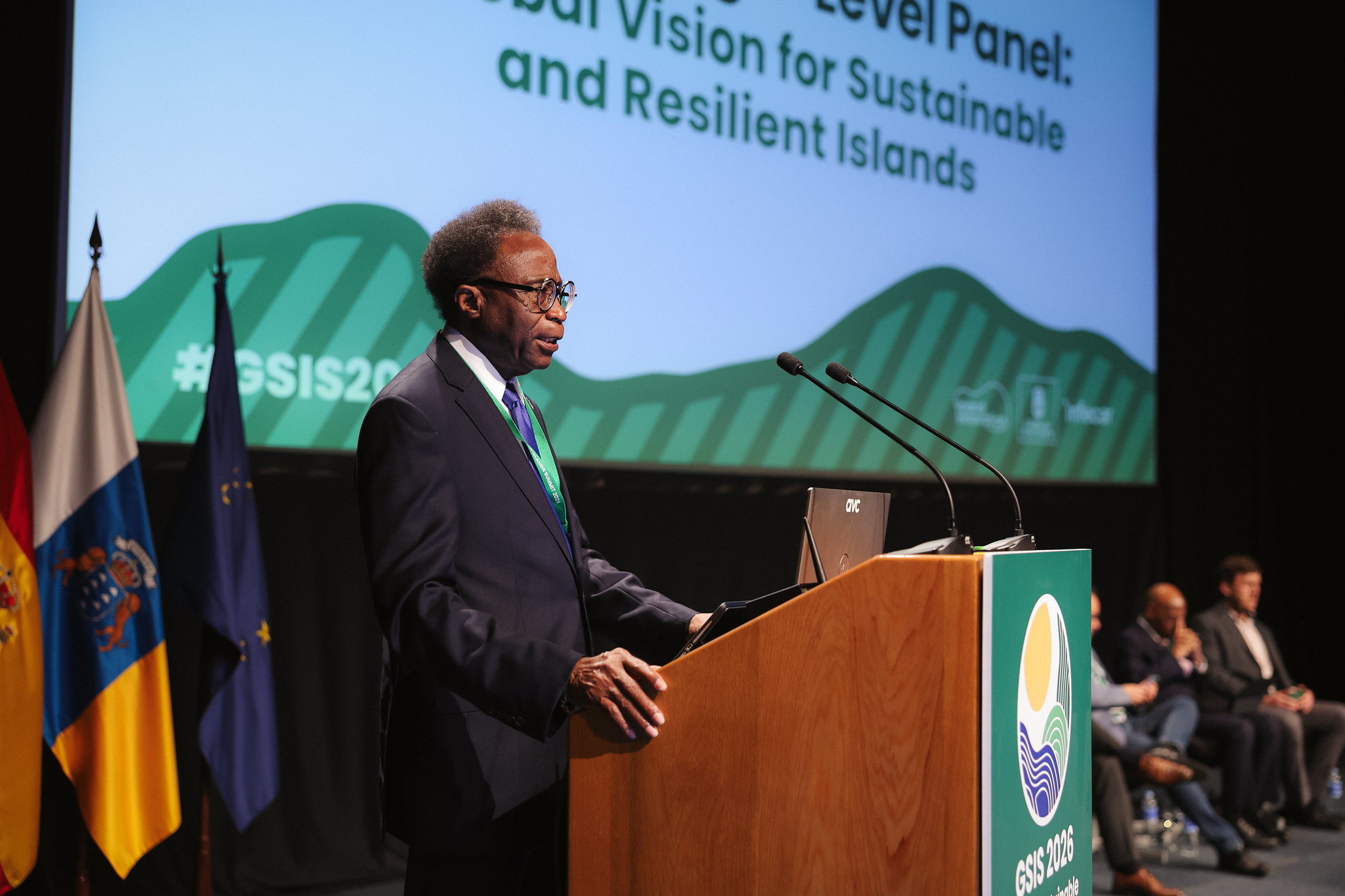
Julian Fraser. MHA. Deputy Premier of the British Virgin Islands.
What the VICCTF Actually Does
The Fund's response to this problem is institutional rather than political. Rather than waiting for the international climate finance system to revise its eligibility rules, the VICCTF creates a locally governed, independent, and internationally credible mechanism that can engage directly with donors, development institutions and private investors on terms they recognise.
It is structured to mobilise and deploy funding across energy, infrastructure, water, tourism, environment, agriculture, fisheries, health and financial services, guided by the Virgin Islands Climate Change Policy. It supports a broad range of implementing actors: government agencies, NGOs, the private sector, academia and registered associations. Its governance meets international fiduciary standards, which is precisely what makes it credible to the global institutions it needs to attract.
CEO Chamberlain Emmanuel described the operating logic using the concept of a lever: a small-to-moderate, concentrated institutional effort capable of generating large flows of resources for on-the-ground impact. He framed the Fund not as a single financing vehicle but as something more integrated:
"It is not just a trust fund. It is an ecosystem. It's an entire ecosystem mechanism that pulls in the capacity of multiple institutions at all levels. We are a legally established, independent, operationalised entity and ready to do business with you."
Why GSIS, and Why Now
The decision to launch at the Global Sustainable Islands Summit was deliberate. GSIS is structured specifically around the challenge of delivering sustainable development in island environments, and it brings together the precise community the VICCTF needs to engage: island governments, regional development institutions, impact investors and implementation partners.
Emmanuel was direct about what the summit offered that no other venue could: "
"This international launch of the Trust Fund at GSIS in Gran Canaria is a significant milestone, giving us the visibility and traction we need with global institutions, the private sector, impact investors and others who share our vision of creating the world's first climate-smart island chain."
Launching here placed a working model of island-owned climate finance in front of the people most likely to replicate it, fund it or partner with it. Launching at GSIS signalled readiness to the world.
What Happened on the Day
The ceremony opened with a keynote from Deputy Premier and Minister of Environment, Natural Resources and Climate Change, Hon. Julian Fraser, RA, followed by remarks from Climate Envoy Dr Kedrick Pickering on the Territory's broader climate strategy, and a technical presentation from Emmanuel on the Fund's design and financing approach. The session was livestreamed to a global audience.
The centrepiece of the ceremony was a handmade model of a traditional Virgin Islands sloop, built by Samuel Davies. The sloop was passed from the policy level to the Fund's governance and management level, marking the formal transfer of operational responsibility. It was a grounded, specific gesture that connected the Territory's cultural identity to the act of institutional launch. The Fund's new logo and updated website were unveiled at the same session. Visitors to the VICCTF exhibition booth could navigate a live impact map charting projects aligned with the Virgin Islands Climate Change Policy, and sign a hand-crafted commemorative tapestry of the new logo.
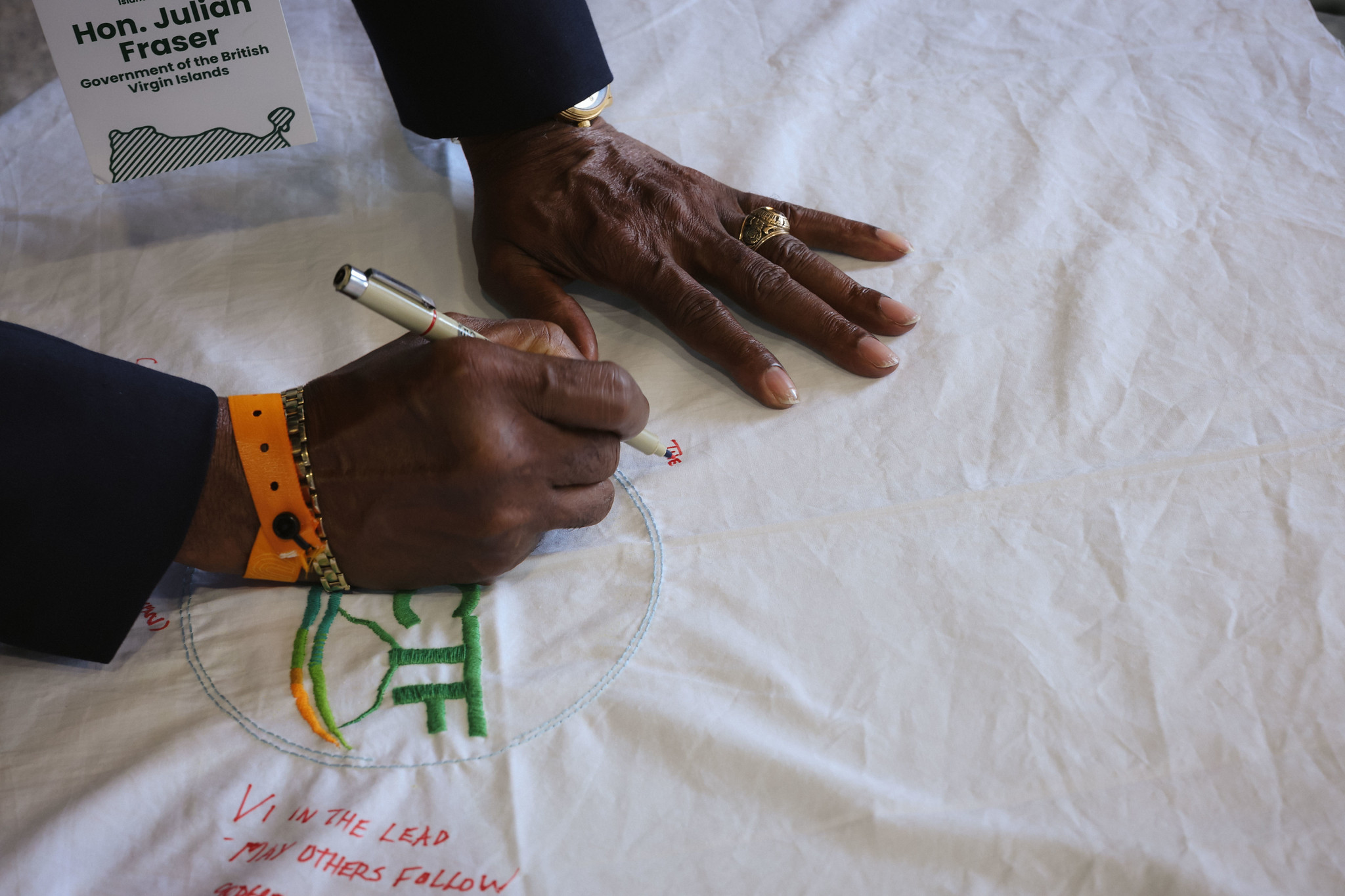
Hand-crafted commemorative tapestry of the new VICCTF logo.
Fraser opened with a statement on the historical weight of the moment: "There are moments in the history of every country that define and shape its future; the launch of the Virgin Islands Climate Change Trust Fund is one of those moments for The Virgin Islands."
He continued: "It is a trusted, credible bridge to connect innovative sources of indigenous and international climate finance with local priority projects to build our resilience and transition to a lower carbon economy."
He also placed the Fund within the Virgin Islands' long history of excellence: "The Virgin Islands is no stranger to innovation and global leadership, and we are well placed to lead in a climate adaptation and innovative finance space."
And he was clear that the VICCTF, whilst essential, is not only the Territory's answer: "The trust fund is not only our answer. It serves as a model to unlock climate finance for overseas territories that face the same barriers to access as we do, as well as small island development states around the globe."
Board Chairman Edward Childs confirmed the next phase: "The Trust Fund is looking forward to a series of local engagements across The Virgin Islands following the international launch, noting that the success of the Fund rests with the people of The Virgin Islands, the ultimate beneficiaries of the Fund."
The Partners Who Showed Up
The breadth of institutional support at the launch was significant. Endorsing messages were played from the CARICOM Secretariat, the Organisation of Eastern Caribbean States, the UN Resident Coordinator Office for Barbados and the Eastern Caribbean, the Caribbean Centre for Renewable Energy and Energy Efficiency, the Caribbean Biodiversity Fund, the Global Island Partnership, the Development Bank for Resilient Prosperity and Island Innovation. The Governor of the Virgin Islands, His Excellency Daniel Pruce, also provided a congratulatory message. The Fund's operational manual was developed with support from the OECS Commission, and its legislation was supported by the Caribbean Community Climate Change Centre.
These are not symbolic endorsements. They represent institutions with financing capacity, regional reach and implementation networks, whose support positions the VICCTF as a credible counterpart for international engagement rather than an emerging concept. Watch the partnership endorsement video.
What Comes Next
The local engagement programme beginning across the Territory will bring the Fund's message directly to communities, civil society, the private sector and academia within the Virgin Islands. The first calls for proposals are in preparation. The impact map on the updated website already charts projects aligned with the Virgin Islands Climate Change Policy, giving potential partners a concrete picture of where resources will flow.
At the international level, the Fund is now visible and open. The GSIS launch gave it the platform to begin conversations with the global institutions and investors whose participation will determine the scale of what it can deliver.
A Reference Point for Other Islands
The broader significance of the VICCTF is that it demonstrates something which has not existed before within a UK Overseas Territory: a locally governed, legally constituted, independent, internationally credible climate finance mechanism that works within the constraints of the current system rather than waiting on that system to change.
For other island territories, the Fund is both a case study and a potential vehicle. The structural barriers are shared. The institutional response is replicable. As Fraser put it at the launch, the Virgin Islands "does not need to choose between development and resilience. We have made that decision. We welcome partners who share it."
That is the conversation GSIS was built to host. The launch of the VICCTF was one of its most concrete outputs in 2026.
More information and partnership opportunities are available at www.vicctf.org. Watch the official launch video and the partnership endorsement video.