
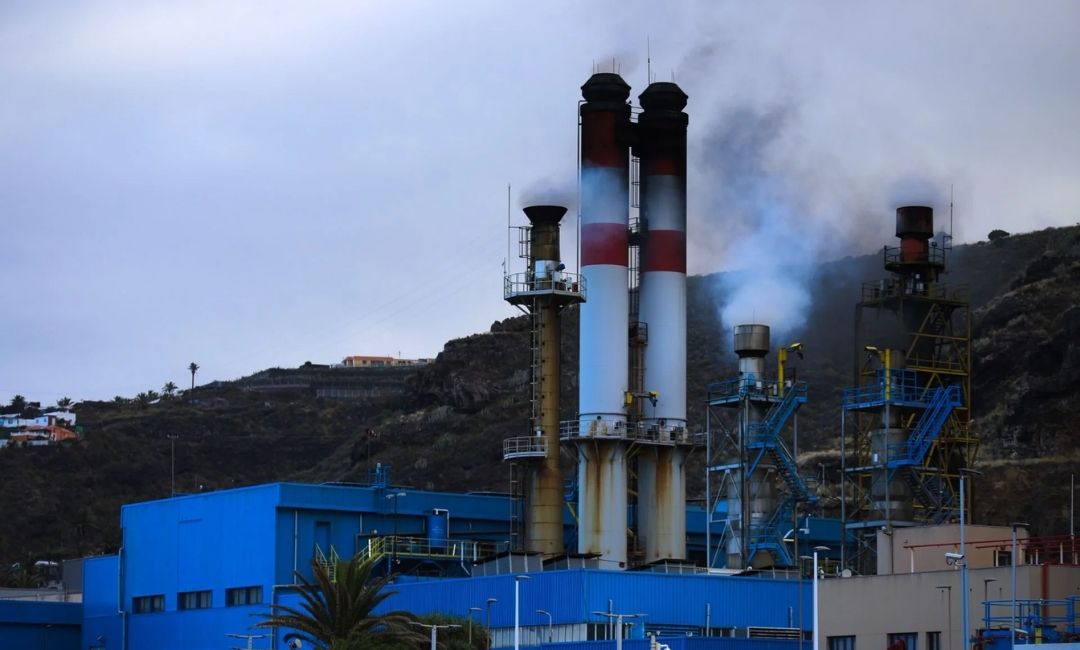
Photo credit: EFE / Canarias7 – Image of the Los Guinchos power plant in La Palma.
This text has been translated with minor modifications.
In the midst of a transition towards a sustainable energy model, Gran Canaria faces an alarming contradiction: they are wasting part of the renewable energy they generate. This is called ‘curtailment’ or ‘supply cutting’, and it means that when the sun shines or the wind blows strongly, part of that clean electricity goes unconsumed because the island’s electrical grid cannot absorb it. An inadmissible luxury in the midst of a climate emergency.
The data is compelling. According to Red Eléctrica de España, in just the first 5 months of 2025, the percentage of renewable energy wasted in Gran Canaria has exceeded 19.38% (being 24% in April and 25% in May), multiplying by 2.2 the value from the previous year (an increase of 10.72%). This is not a one-off failure, but a structural symptom of island electrical systems. Furthermore, the inability to evacuate all the energy generated not only represents environmental waste, but also a direct reduction in the profitability of renewable projects, which see their income reduced without compensation in many cases.
The underlying reason is clear: our networks are not prepared to manage a large-scale renewable system. It is necessary to strengthen distribution networks to be able to adequately integrate both renewable energies and storage systems. And this is where a key piece comes into play: energy storage. Without it, Gran Canaria cannot unleash the full potential of our clean energies.
In Gran Canaria, steps are already being taken. The Salto de Chira hydraulic pumped storage hydropower project, with capacity to cover up to 36% of the island’s peak demand, is underway. Various battery initiatives being promoted by the Consejo Insular de la Energía are also advancing. And green hydrogen, still emerging, is beginning to take shape as a long-term storage solution with multiple applications. In this regard, the RESH2PORT project stands out, led by Megaturbinas de Arinaga (with participation from the Cabildo, the Port Authority and ITC), which plans to install an electrolyser at the Port of La Luz and produce 40 tonnes of hydrogen annually to supply between five and six zero-emission public buses. But a few good projects are not enough. Gran Canaria needs political will, adequate financing and agile procedures.