
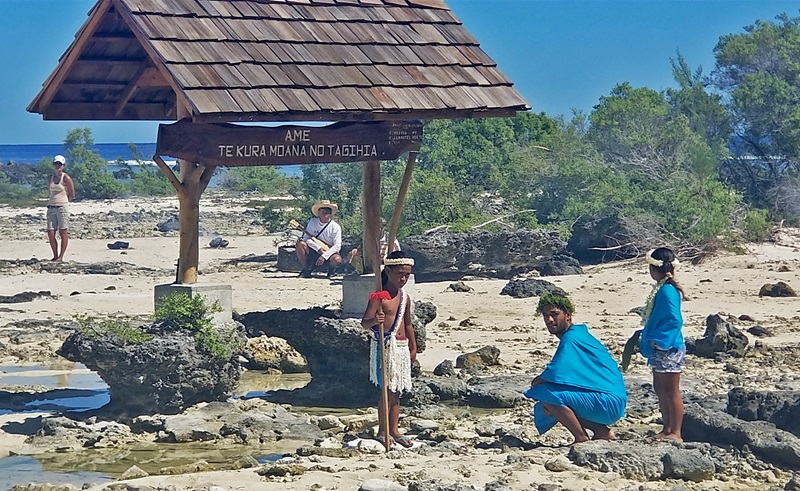
Image courtesy of Alexander Filous. Retrieved from news.mongabay.com
It’s Mass Day in Fenua Aihere. There are no roads to this part of the island of Tahiti — it’s only reachable by boat. It’s Monday, not the typical day for Mass in a Catholic community in French Polynesia. But here, everyone is a fisher or the wife, daughter or son of one. And on Sundays, they all head to the market to sell their catch, either in Taravao, the nearest city, or across the island in Papeete, French Polynesia’s capital.
Songs in Tahitian and French resonate inside the town’s small concrete church. Everyone listens carefully to the deacon’s speech, even though the temperature and humidity are nearly unbearable. The service lasts just over an hour. After one last song, believers leave the church and move on to the tasks of the day: taking care of the house and the kids, or getting ready to go out fishing.
Fishers will head into the clear blue lagoon of Tautira municipality, but they must avoid the waters right off Fenua Aihere. Since 2018, 265 hectares (655 acres), about 10% of Tautira’s lagoon, have been protected with a rāhui. This Tahitian word indicates an area of land or sea where it is forbidden to take any resources, and in some cases even to enter.
“I think it is a very good thing,” says Célestin Tevarai, a fisher like his father and grandfather, who sits on a bench in the church’s courtyard after the service, facing the blue lagoon. “It helps us protect the fish and to be sure that tomorrow our children will still be able to fish and feed themselves.”