
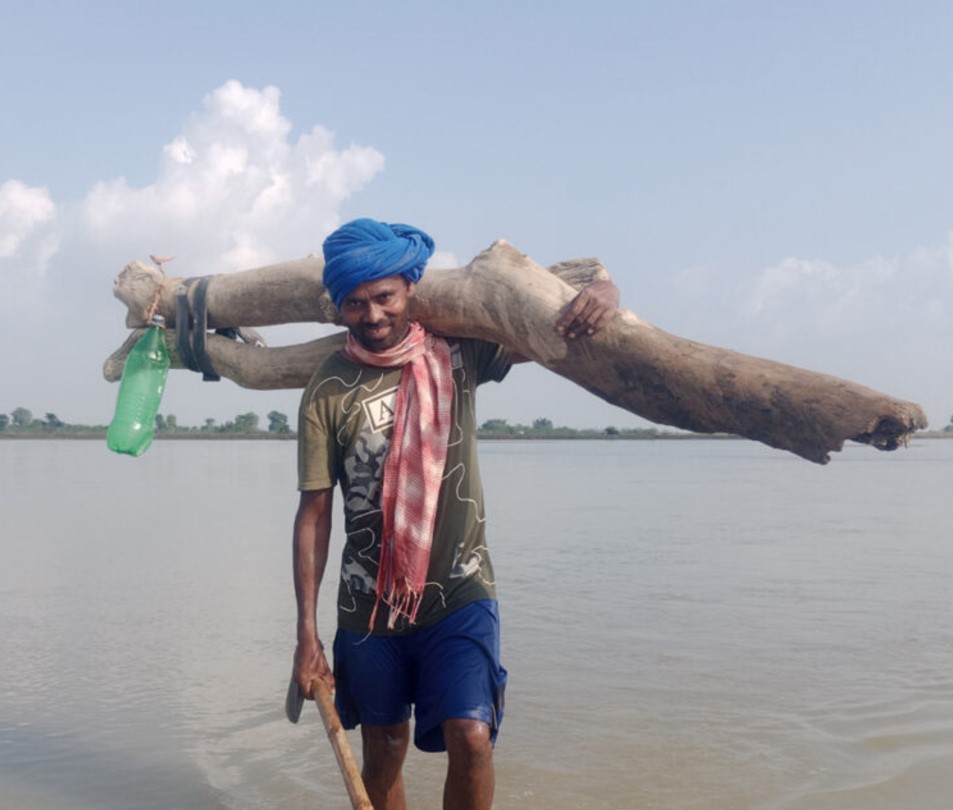
Photo by Rahul Singh for Mongabay. Retrieved from india.mongabay.com
After heavy rains in many parts of Nepal and Bihar in the last days of September 2024, the Kosi region faced a devastating flood after decades. The impact of the flood was visible even after weeks. It uprooted the lives of people living between the two embankments built on Kosi. The flood destroyed the crops, animal fodder, and food grains of thousands of families living between the embankments and left them mentally and physically exhausted.
The Kosi river, known for its floods and velocity, divides into several branches in this region and keeps changing its flow rapidly. For this reason, it is difficult to assess the intensity and direction of floods in the Kosi region. Due to the division of the river, many islands are formed in these areas which are called ‘chhint’ in the local language. At many places along the Kosi, one can see islands where people live in mud houses. In the case of erosion on one patch, people shift to another part of the same patch or settle on another patch. There are about 300 villages scattered along the river and the families living here, which includes climate- displaced persons, are forced to change their place of residence every time due to the submergence.
Subhadra Devi, 55, who lives on one such patch in Belagoth village in Supaul district, told Mongabay India in a choked voice how the flood has badly shaken her and her family. The little farming land she owns is submerged in the flood water. Her family of six includes her husband Vishnu Mandal who does farming work. The couple has four sons—the three elder sons work outside as migrant labourers, and the youngest son Rahul, 14, is in class nine.