
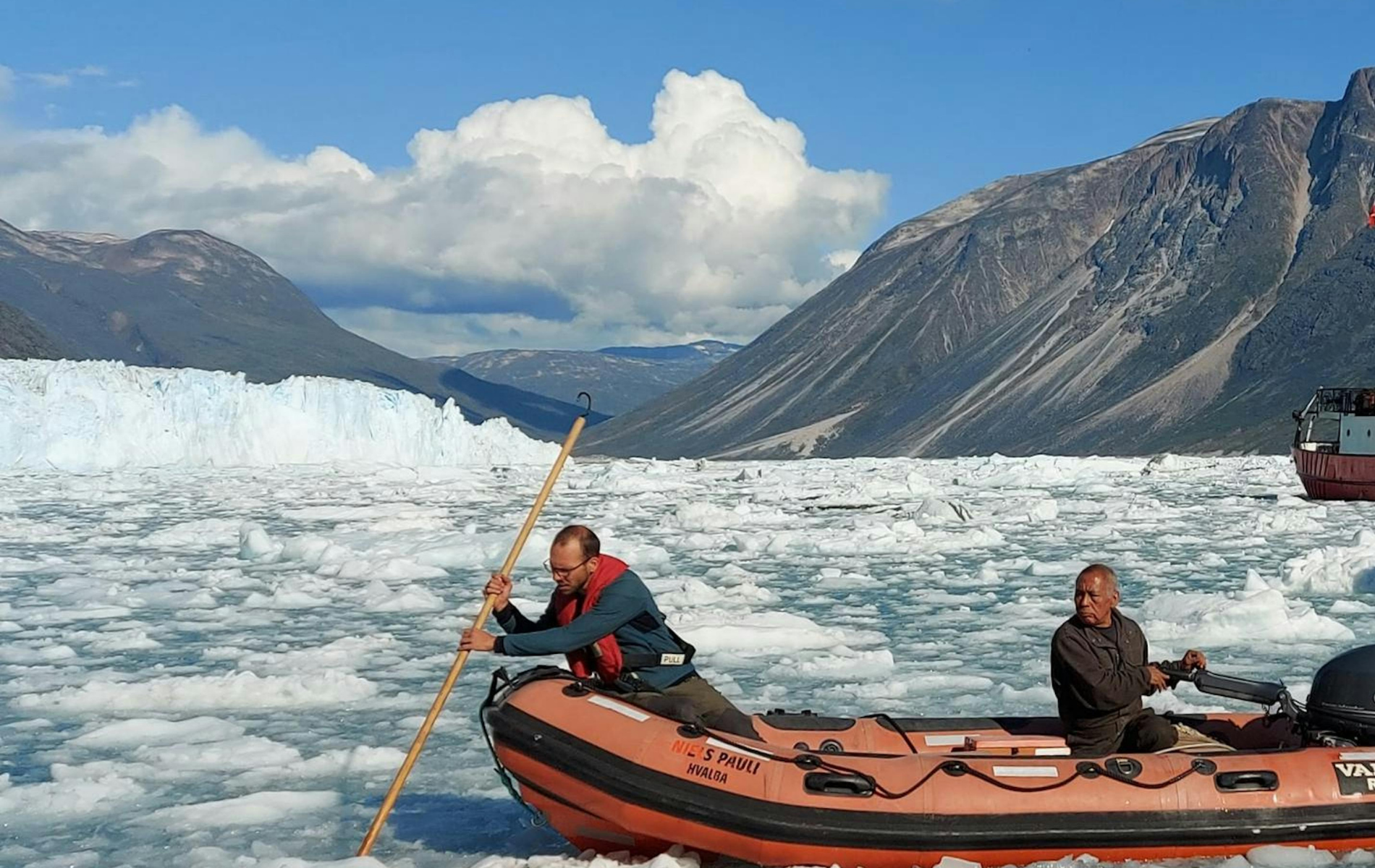
Excerpt from dailyuw.com
Gradual loss of the Greenland Ice Sheet (GrIS) holds global significance: it exacerbates sea level rise, alters ocean circulation, and threatens Arctic ecosystems. But melt is difficult to quantify. It’s a nonlinear process driven by myriad feedback loops, or reinforced outcomes, and the majority occurs below the ocean’s surface.
In the past, GrIS loss monitoring has been limited to computer simulations and Sound Navigation and Ranging (SONAR), which uses sound waves to measure glacier thickness. A 2019 study directed multibeam SONAR at glacier fronts, combined with several other technologies, to simulate a projected loss rate. This projection underestimated ice loss by two orders of magnitude.
As glacier loss occurs, the glacier itself is exposed to overall lower elevations, which contain warmer air. This exacerbates melt and creates a positive feedback loop. Still, above surface observations are only 10% of the story. Approximately 90% of GrIS is below the surface, and submarine feedbacks are largely unknown.