
On U.S. Barrier Islands, African-Rooted Traditions Protect against a Relentlessly Rising Ocean
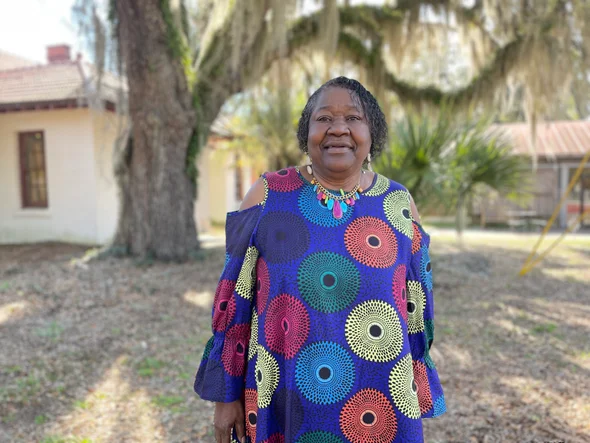
Photo: Joanna Heyward’s family has owned land for six generations on South Carolina’s Saint Helena Island, a center of Gullah Geechee culture. Credit: Sara Novak. Retrieved from scientificamerican.com
Saint Helena is one of the few remaining sea islands in the U.S. that recalls an earlier era. Some Gullah Geechee people have held onto their lands since the first enslaved people arrived in what would become South Carolina in the 16th century. Elsewhere along the coast, Gullah Geechee families have yielded their lands to developers of hotels and vacation homes and upscale gated communities. Dating from the end of the Civil War, Gullah Geechee families have lost more than 14 million acres of family property, and only around one million acres owned by the formerly enslaved group is still in family hands.
Occupying 64 square miles, Saint Helena is one of the centers of Gullah Geechee culture. It’s a vast swath of pristine coastal land dotted with maritime forests and salt marshes. Gullah Geechee people on Saint Helena still own their land because their ancestors put up cash to obtain deeds in the 19th century. On other sea islands along the South Carolina coast, formerly enslaved people were given the lands initially and then were pushed off them after Reconstruction. After Abraham Lincoln was assassinated and Andrew Johnson, who held deeply racist beliefs, became president, the land was returned to former plantation owners.* But on Saint Helena, Gullah Geechee people bid on land at auction and split it up into family compounds such as the one owned by the Heyward family, who still live on their property more than 150 years later. The island has a cultural protection overlay (CPO), a zoning ordinance that gives protection against development of these lands.
Those who remain on Saint Helena hope to stem the tide of generational changes elsewhere in the Gullah community by refusing to give up titles on their lands. Their self-sufficiency—adapted to living in harmony with the coastline, especially in how the land is developed—may prove vital to preserving the South Carolina coastline against rising seas in the years ahead. From hunting deer, wild boar and squirrels to cultivating rice, watermelon, sweet potatoes, red peas, okra, peanuts and butter beans, the Gullah Geechee know how to thrive on land that others have found punishing. Like the tides, their way of life has an ebb and flow to it that is built and rebuilt as the waters rise and retreat.