
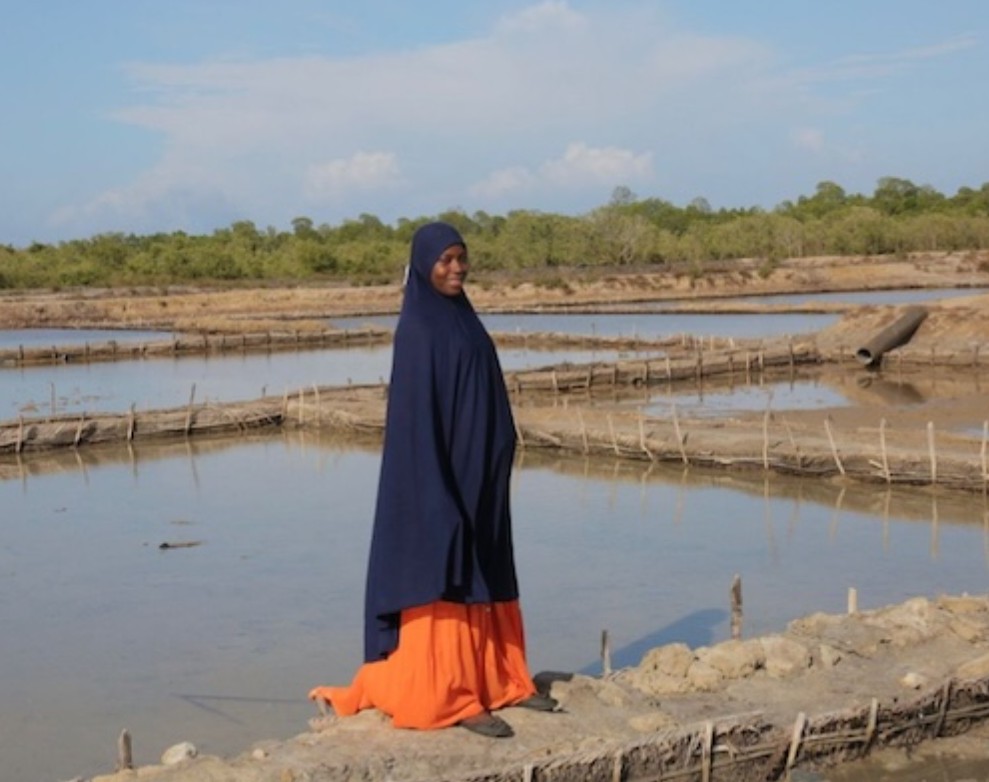
Photo Credit: Kizito Shigela/IPS
As the cool morning breeze sweeps across the Indian Ocean beach in Tanzania’s Pemba archipelago, Salma Mahmoud Ali begins her day. With her brightly coloured Kikoi cinched tightly around her waist and a dark blue scarf framing her face, she walks barefoot toward her salt ponds. The humid air hangs, but Ali wades through ankle-deep water with courage.
Armed with a shovel, rake and pick, she methodically drags sparkling crystals under the rising sun. Each stroke pulls salt from the brine—a hard process born of necessity.
“It’s a tough job,” says Ali, a 31-year-old mother of three. “The heat is too much—no matter how much water you drink, the thirst won’t go away. But it’s how I feed my family and send my children to school.”
For Ali and dozens of female artisanal salt farmers in Pemba, salt production is both their livelihood and their struggle. In this deeply patriarchal Muslim community, the gleaming piles of white salt represent survival—a craft demanding patience, precision and grit.
On Pemba Island, where farms yield 2,000 tons of salt annually, prosperity feels like a mirage. Experts believe output could triple with better tools, but resources remain scarce. Families and cooperatives divide the land, with an average of four owners per plot, leaving wealth unevenly distributed. Farm owners collect the bulk of the earnings, while the workers—who toil under the weight of every harvest—are left to scrape by, their paychecks barely carrying them through the season.
Most families rely on coarse, untreated salt, with only one in four affording iodized varieties. “It’s our life,” said Halima Hamoud Heri, a laborer, kneeling under the blazing sun. “Hard, but it keeps us going.”