
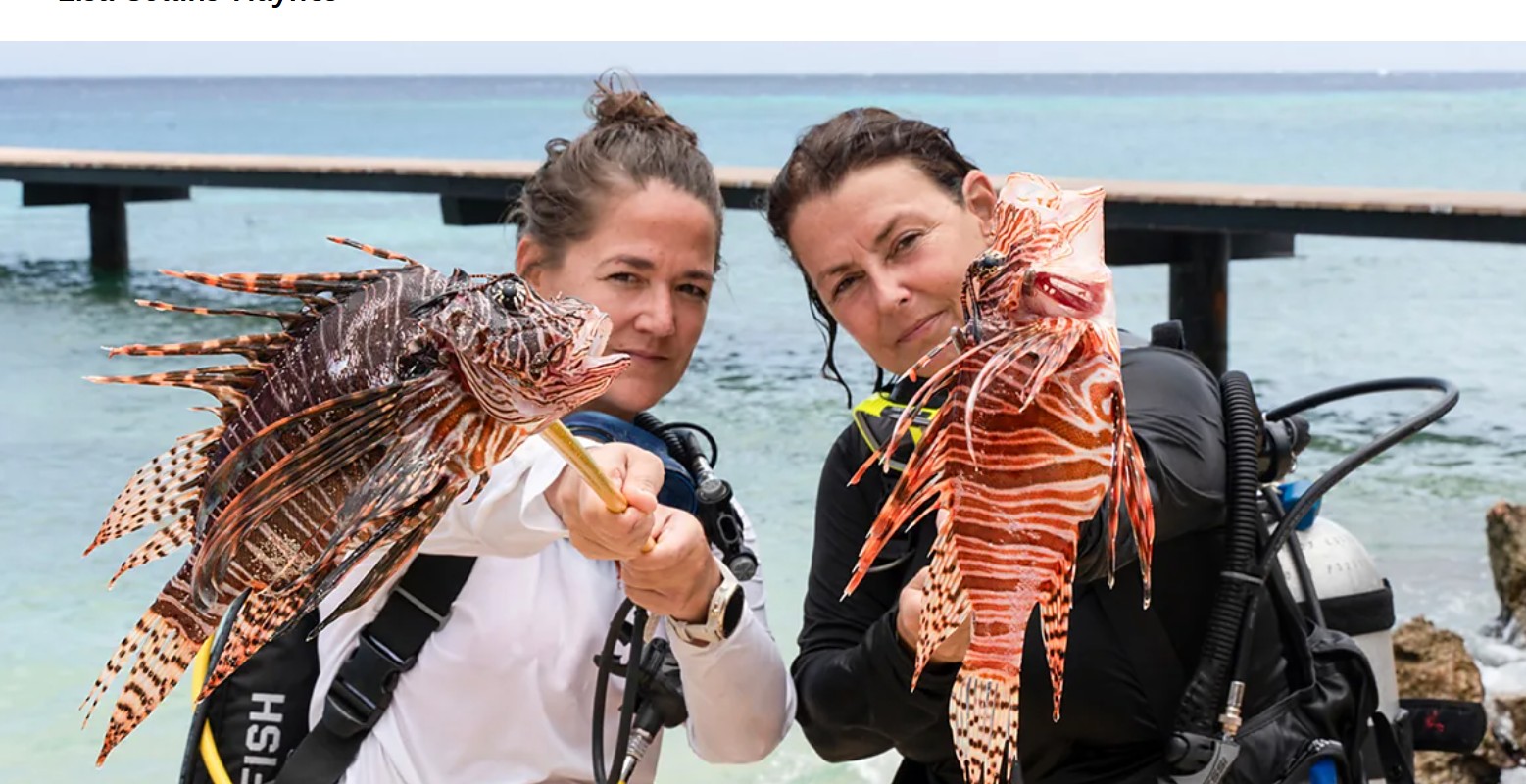
Photo Credit: Charmed Life Photography-Lisa Haynes. Retrieved from bbc.com
Two women are working to save the coral reef from the invasive lionfish, using it as a sustainable teaching tool and cooking it into everything from tacos to fish and chips.
Curacao is facing an ecological challenge: the invasive lionfish. The venomous lionfish have brown, red and white zebra-like stripes, fleshy tentacles and long, fan-like fins. They are native to the South Pacific and Indian Oceans, but sometime in the late 1980s they were introduced to the warm tropical waters off Florida’s Atlantic Coast. Although the exact cause of this is unknown, it’s theorised that they were released from marine aquariums. By the early 2000s, they had reached the Caribbean coastline and Curacao’s coral reef, where diving significantly contributes to the local economy and employment.
Lionfish are not a welcome species anywhere because they reproduce at an alarming rate; females release about two million eggs per year and as they grow, they eat smaller native fish and marine life that protect coral reefs. This behaviour creates an imbalance that disrupts the reef’s ecosystem. The presence of lionfish impacts both diving tourism and the commercial fishing industry, with research showing that even in a short period of time, the presence of lionfish can reduce a native reef fish population by 79%.
But what is problematic has become a catalyst for innovative adaptation and environmental responsibility. Through food, art and education, the unique but complicated relationship between Curacao and its lionfish is being tackled by two local women, Helmi Smeulders and Lisette Keus.
Smeulders left her law career in the Netherlands in 1998 and relocated to Curacao, eventually becoming a chef, diver and conservationist. But what did a lawyer-turned-chef know about hunting the invasive lionfish, sustainable fishing and the importance of protecting the reef for future generations? Turns out not much, until she teamed up with local diver Keus, who taught Smeulders (along with other women on the island) how to find and capture the lionfish to help save the coral reef. “I showed [chefs] how to clean them, gave [them] recipes and gave batches [of the fish] for free to restaurants to practise with,” says Keus.