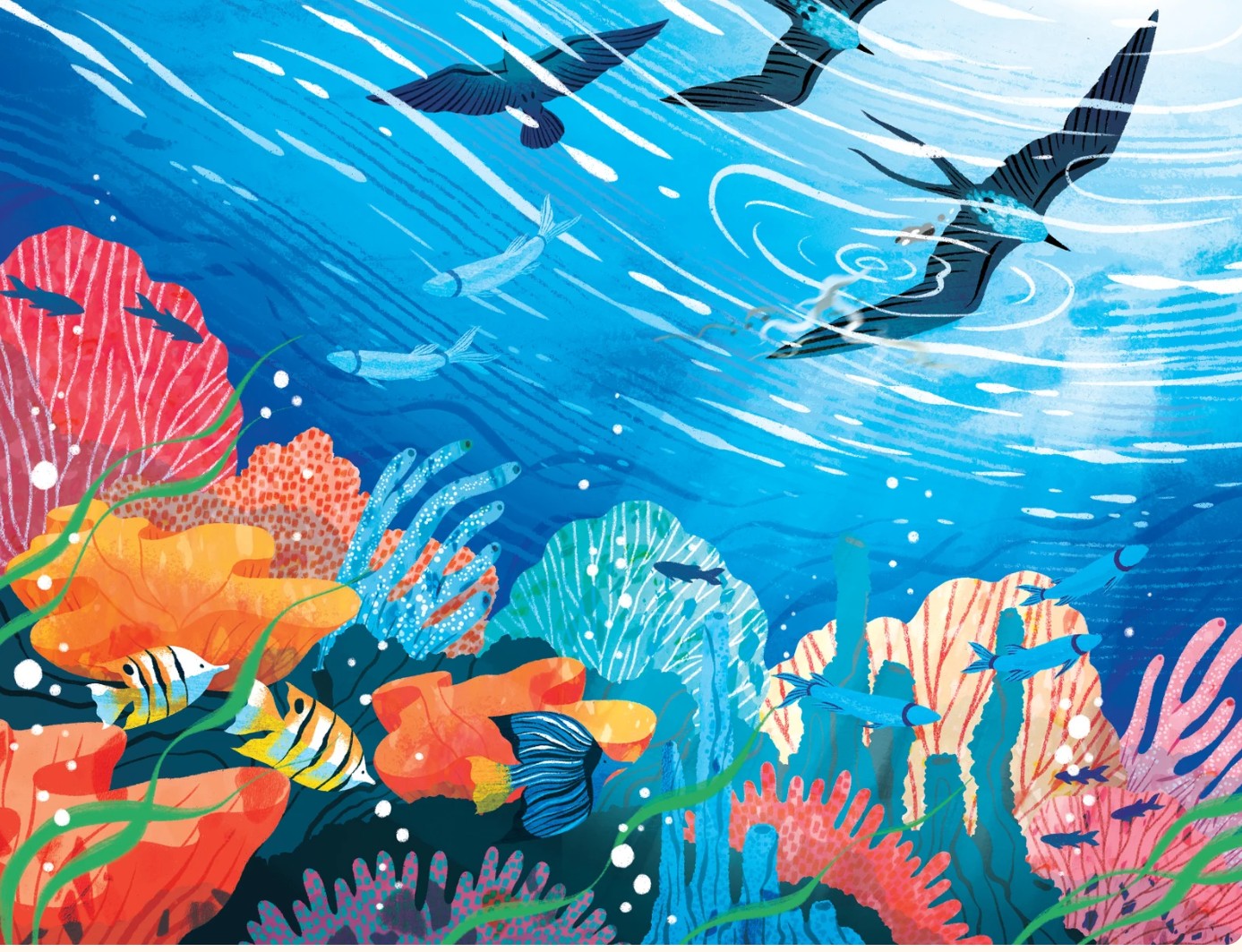
Illustration by Amy Grimes. Retrieved from audubon.org/magazine
When marine ecologist Casey Benkwitt set out to study coral reefs, she never thought she’d spend so much time thinking about bird poop. Now, six years after she started exploring how seabird guano boosts these underwater biodiversity hotspots, she sees how important it is to look for unexpected links in ecology. “It’s really intriguing and inspiring to think about how everything is connected,” she says.
The Chagos Archipelago, a cluster of more than 50 islands in the Indian Ocean, is home to about a million seabirds, including 282,000 nesting pairs that produce a squawking cacophony and a strong scent of guano. But not all of the Chagos islands are equally raucous or smelly: More than half have few or no seabirds at all. Avian populations on these quieter coasts were decimated by invasive rats, which arrived with ships centuries ago and eat eggs and chicks. (Only one of the islands’ seabird species—Red-footed Boobies—can defend itself and its chicks.)
By comparing marine life near islands with and without seabirds, Benkwitt and her collaborators have shown how healthy seabird populations boost coral reef health. The birds’ guano offers an infusion of nutrients—helping corals grow faster and fish thrive.
The team’s findings are now informing efforts to protect and restore seabird habitat on Chagos and may add urgency to island conservation projects elsewhere in the tropics. “When we actually put our efforts into restoration on islands, it can have these cascading benefits,” says Benkwitt.