
UNC Ph.D. student’s cutting-edge science helps conserve critically endangered scalloped hammerheads in the Galapagos
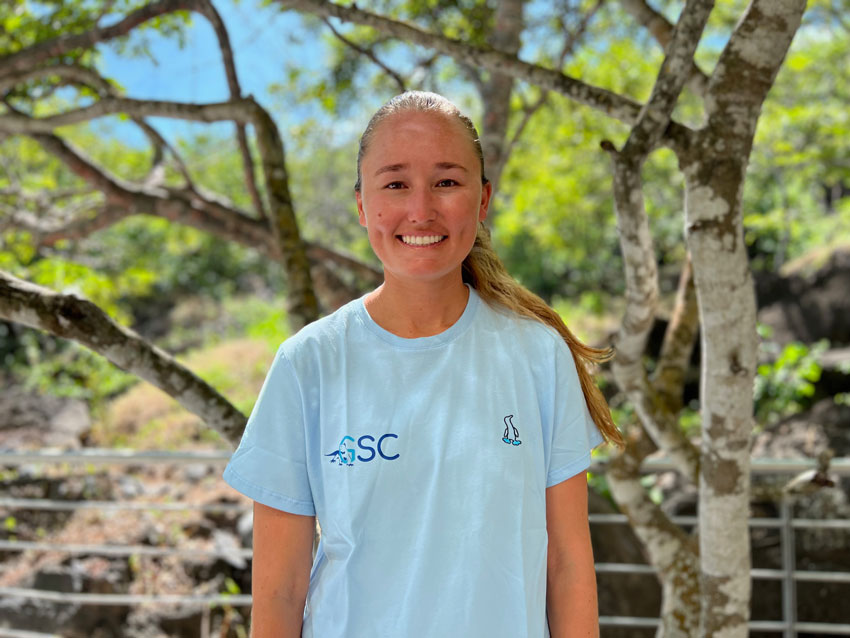
Photo retrieved from galapagos.unc.edu
A UNC Ph.D. student in the Environment, Ecology and Energy Program in the College of Arts and Sciences, Savannah has dedicated the last five years to researching the diet of juvenile blacktip and scalloped hammerhead sharks in the Galapagos Islands using a cutting-edge technique called metabarcoding. She supplements her study of their diets with information about their movements, such as the data she collected during her 24-hour tracking project.
This tracking project, during which she did not lose the shark’s trail once, is not the first time Savannah has proven her dedication to her research – or how important her work is. Juvenile blacktip and scalloped hammerhead sharks spend this part of their life cycle in bays around the Galapagos, and while the juvenile blacktip populates bays all over the archipelago, there were only two known bays occupied by juvenile scalloped hammerheads when Savannah began her research five years ago.
However, during the summer of 2022 Savannah, along with members of the Galapagos National Park, discovered a new juvenile scalloped hammerhead nursery bay on Isabela Island. Savannah and the team from the national park spent two weeks exploring different bays around the archipelago but only found juvenile blacktips. It wasn’t until the final bay on their final day of the trip that the team struck gold. They dropped lines and immediately caught five scalloped hammerheads, a discovery vital not only for Savannah’s research but also the collective knowledge about the sharks’ habitats in the Galapagos.
For Savannah, the effort required in her work is a worthwhile sacrifice for the ability to help these animals, particularly the juvenile scalloped hammerheads, which are a critically endangered species. Their endangered status necessitates Savannah’s metabarcoding technique, a safe alternative to the standard method in diet analysis. The standard method of lethal gut analysis, like its name suggests, involves killing and dissecting a subject to visually determine its stomach’s contents.