
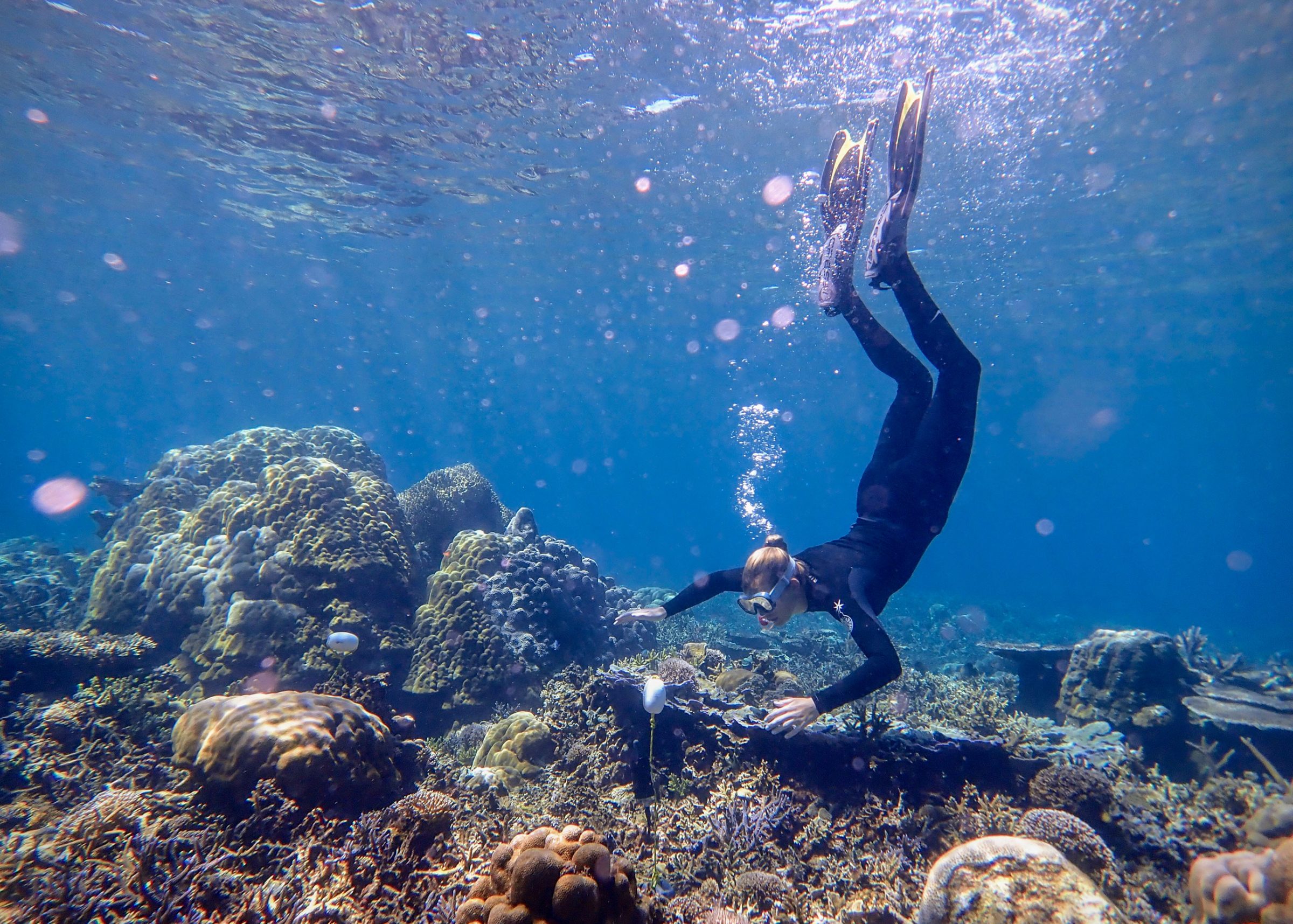
Healthy coral reefs are a cacophony of purrs, whoops and snaps as fish, shrimp, turtles and more go about their daily business. But on some reefs, a less healthy sound can be heard: the rumble of explosions.
Blast fishing is the practice of tossing bombs into the sea. It kills or stuns everything in its vicinity and often destroys the reef structures that support these rich ecosystems.
The Spermonde archipelago, off the south-western edge of Indonesia’s Sulawesi island, is a known hotspot for the destructive practice. But its prevalence has been hard to gauge, until now. An international team has tracked this blast fishing via thousands of hours of ambient sound, all captured by a single underwater audio recorder. The scientists detected thousands of explosions in this data, a process made much quicker thanks to machine learning.
“We know bomb fishing has been an issue in this archipelago and many others around the world,” says the study’s leader Ben Williams, a marine biologist turned AI scientist working with Imperial College London and the Zoological Society of London, United Kingdom. “But the challenge has been, we don’t really know to what extent it goes on. It could be a few bombs get dropped a month, it could be hundreds. This is the first time we’ve got real tangible counts of this.”
One of the most destructive fishing practices on Earth
Central and eastern Indonesia lie within the coral triangle, and its reefs are among the planet’s most ecologically diverse places. The reefs provide coastal communities with food security, jobs in fishing and tourism, and act as a buffer against storm waters.
Blast fishing threatens all of this. Homemade explosives – often fertiliser packed into bottles – are thrown overboard. The blast waves rupture the internal organs of fish, which float to the surface and can easily be scooped into nets.
A typical bottle bomb can kill or stun almost everything within a 10-30 metre radius, according to studies. The pressure waves from explosions can reduce the complex, warren-like structures of slow-growing coral, a habitat for many species, to rubble. This destruction makes it very hard for coral to resettle: juvenile corals need a relatively stable base and they can be damaged or buried when loose rubble is moved by waves and tides.
“Sites that have been bombed 40-50 years ago are still rubble beds,” says Tries Razak, a marine scientist at IPB University in Indonesia, and co-author of the new research.
Even among Indonesia’s thousands of islands, the Spermonde archipelago is often considered especially biodiverse. Local waters host hundreds of species of coral and sponges. They teem with so many fish that they support one of the largest coral reef fisheries in Indonesia.
Satellite monitoring of the Spermonde archipelago reveals that approximately 76% of its live coral was lost between 1990 and 2022. Blast fishing was a key contributor. One study from the 1990s suggests that 10-40% of the fish in a market in the capital city of South Sulawesi province, Makassar (then Ujung Pandang), was caught through blasting. The practice can be identified by characteristic damage to the skeletons, skin and eyes.
A needle in a haystack that keeps moving
Blast fishing has been practised for decades and documented in at least 31 countries. In Indonesia, NGOs including Destructive Fishing Watch Indonesia are pushing against blast fishing through coastal programmes and advocacy work, and it has been illegal since 1985. Outwardly, the authorities take a hard line.
Last year, Indonesia’s national police conducted a campaign that uncovered 72 cases of destructive fishing practices, including blasting, poisoning and electrocution. Police say they arrested 101 suspects and prevented IDR 49 billion (USD 2.7 million) in state losses. Arrests can make the national news, as in June 2025 when six fishermen were caught in North Malaku province with explosive materials and 50 kg of blasted fish.
But in a country of 17,000 islands and 280 million people, the issue competes with many other challenges and political priorities. The reality is that blast fishing happens at scale, monitoring and enforcement is patchy and catching the odd rogue fisher is a drop in the ocean, say experts.
Indonesia’s ocean is actively patrolled by police and other authorities who arrest blast fishers on a regular basis. But the country’s huge ocean area makes chance encounters with active bomb fishers unlikely, and past research has suggested bribery of officials and rapid disposal of evidence as patrols approach is common. Sometimes, blast fishing is revealed when fishers die in accidents while working with explosives.
Even when culprits are known, without clear evidence such as possession of explosives or catching them in the act, it is virtually impossible to prosecute. And tracking those using the method over vast swaths of the western Pacific is incredibly challenging.
Filling the blast fishing data gap
The work led by Ben Williams, with his collaborators in the UK and Indonesia, addresses this challenge.
The team placed an audio recorder, capable of detecting blast fishing within a 17 km radius, near the south-west coast of Sulawesi. Next, an open-source machine-learning algorithm was used to whittle down each month of audio data to just a few hours for human review. Similar approaches have been used in tropical forests to detect poachers.
One challenge was accounting for environmental noise, which can trigger false readings in this kind of work. For instance, Williams says the team had to spend extra time analysing one set of data when an especially vocal choir of fish passed through. They also had to deal with a few data gaps when the recorder was taken by spear fishers, which happened more than once.
Over a 16-month period, they verified more than 3,500 blasts. But the recording was not continuous, so the team have calculated that these figures equate to almost 8,500 blasts per year. This is likely to be causing as much as 160,000 square metres of reef degradation annually.
The bombing occurred year-round, mostly in daylight, with significant reductions during storms and on Fridays – the local day of prayer. This is only the second study with verifiable methods to track the frequency of blast fishing, following a 2017 study in Tanzania. That study used a boat to survey 2,692 km of transects (sample lines drawn across an area of ocean), recording 318 blasts in two months.
“It’s not the smoking gun, but it’s strong evidence that bomb fishing is the primary cause of reef loss in this area,” says Williams.
From demo to real-world tool
Given its small scale, the new study is a proof of principle, rather than a finished solution: this was a single recorder covering a tiny fraction of the Spermonde archipelago, which sits on a shelf spanning 16,000 km2.
To scale up and create a real-time monitoring system would require multiple recorders to triangulate the positions of individual blasts, and to coordinate with local patrols.
Enforcement systems similar to this have been deployed in Sabah, Malaysia. The initiative, a collaboration between the NGO Stop Fish Bombing (SFB) and the Malaysian authorities, repurposed acoustic gunshot detection technology by the US company SoundThinking. The scheme reduced blast fishing by 80% over two years off the coast of the town of Semporna.
Terence Lim, SFB Malaysia’s executive director, says authorities had previously dismissed the blast fishing as “sporadic”. Things changed when they saw the data first-hand and heard recordings of blasts in their waters.
Lim says the mere presence of monitoring systems can make blast fishers think twice: “It’s like a building. If you only fence it, someone will try to come in. But with 24/7 CCTV, generally humans behave differently.”
Bombers, however, find ways to evade the reach of static audio recorders, such as hiding behind islands and other natural features. In response, SFB is developing a boat equipped with built-in audio sensors to enable mobile recording.
Open source and scalable
One of the promising features of the study by Williams’ team is the use of a new type of underwater audio recorder. They cost USD 150 each and use free software that works on a standard laptop. Until recently, the predominant device for this type of study cost around USD 3,000, and blast fishing monitoring systems have often historically relied on private international funding.
“If we can build this system that is open source, and copy and replicate it, that would be very new. It would mean people are able to build on top of it and improve it over time,” Williams tells Dialogue Earth.
Monitoring systems may be more economical than focusing on conservation after the damage is done. One study in Indonesia’s Komodo national park found that reef rehabilitation efforts cost between five and 70 times more than marine patrols to enforce blast fishing bans.
Driven by poverty?
The best way to reduce bomb fishing damage is to stop fishers from doing it in the first place. That requires an understanding of why people use the method.
Poverty is often cited as a cause, but that may be too simplistic according to some experts. Researchers behind a comprehensive review of blast fishing literature, published in 2021, concluded that insufficient governance and enforcement were the primary drivers.
Melissa Hampton-Smith from James Cook University, Australia, was the lead author of the 2021 review: “I don’t think it is correct to say that, inevitably, when we have poverty, we will then have destructive fishing.” She believes the best approach to long-term management is effective enforcement, combined with marine protected areas developed and run with local users.
In Tanzania, an enforcement campaign reduced blast fishing despite the precarity of livelihoods, she says. Community groups were given agency to coordinate with fishers, often through voluntary patrols, to preserve the marine environment.