Case study / learning in action
A Course Seat That Turned into a Field Placement in the Pacific
How one introduction through an Island Innovation course became a year of research and hands-on work with The Greater Good in Samoa and Tuvalu.
South Pacific household waste that is diapers
Families surveyed in Funafuti
Weeks to create nutrient-rich soil
The opening
Island Innovation offered a scholarship on the first cohort of its online course to Tanvi Gaur, a Morehead-Cain scholar at the University of North Carolina at Chapel Hill. The course also provided access to practitioners already leading sustainability projects.
Browsing the course participants page, Tanvi found Dr Jason Graham-Nye, co-founder of The Greater Good, a compostable diaper programme working to end plastic nappy waste in the South Pacific. She reached out. That message became a research collaboration that took her from a study in Samoa to a placement in Tuvalu.
The context
The Greater Good was built to address a specific problem: 27% of household waste in the South Pacific is diapers, according to a 2022 SPREP report. Plastic nappies are also one of the largest contributors to the global plastic waste crisis, according to UNEP.
Its response is a door-to-door compostable diaper service. Diapers are delivered and collected at price parity with plastic alternatives, then composted with garden waste using the SPICE method to produce nutrient-rich soil in six to eight weeks.
The model is designed around women: mothers shape the service, and local women are employed to run it. The Greater Good works with the Governments of Samoa and Tuvalu, Poutasi Development Trust and Plant & Food Research NZ, with support from Digicel and Fiji Airways.
The contribution
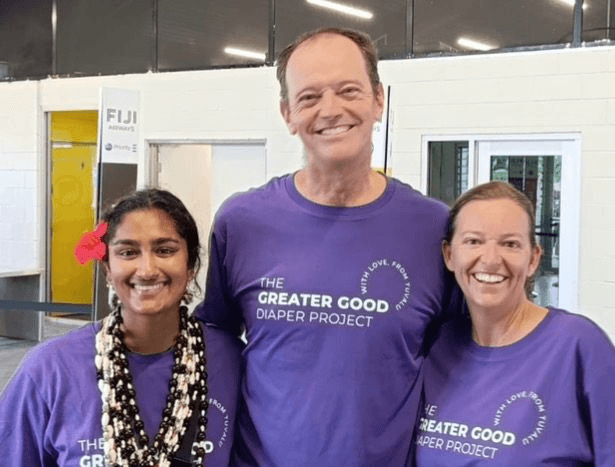
Tanvi's work spanned two research placements funded by the Morehead-Cain Foundation. In Samoa, she identified native feedstocks for biomaterials, supporting The Greater Good's aim to manufacture nappies in-region rather than importing them.
In Tuvalu, Dr Graham-Nye credited her as instrumental to the launch, from analysing consumer data to developing the inoculant used in the composting process. She also analysed survey data collected from 300 families in Funafuti.
The takeaway
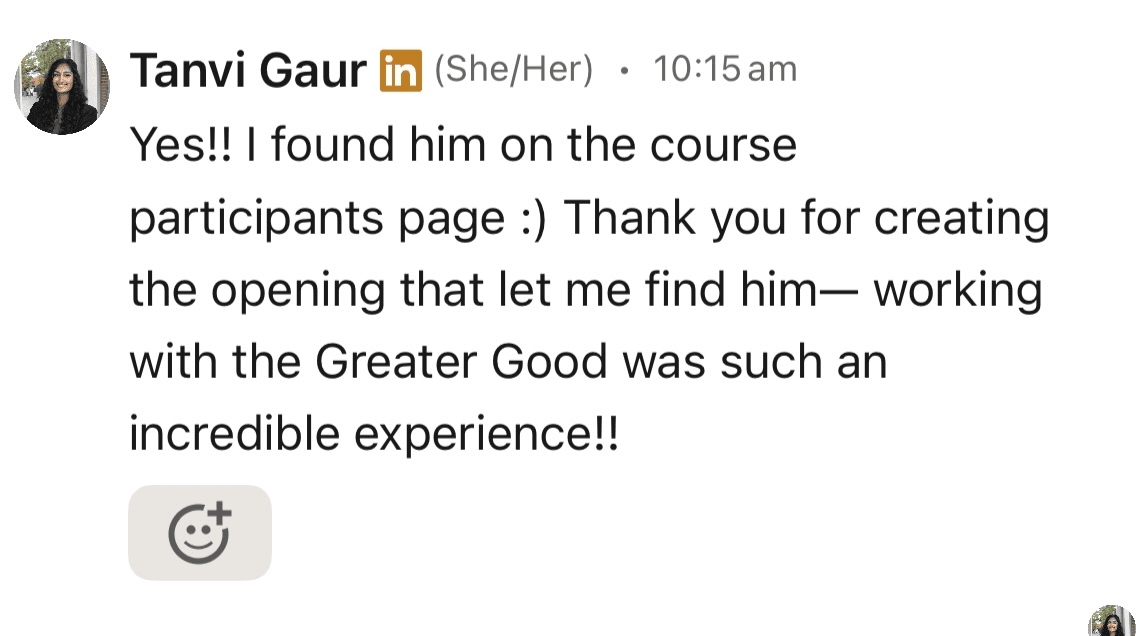
“Yes!! I found him on the course participants page :) Thank you for creating the opening that let me find him— working with The Greater Good was such an incredible experience!!”
The course was not the end point. It was the introduction. A participants page turned into a message, and that message turned into a year of collaboration with The Greater Good, including two months in the field across Samoa and Tuvalu.
Samoa was the pilot, where Tanvi's research explored local sourcing and manufacturing options. In Tuvalu, the programme is scaling nationally as part of an effort to make the country the first in the world to eliminate plastic nappy waste entirely.
For students and early-career professionals, the course offers a route into the network of people already running island sustainability projects. For organisations working on the ground, it offers a channel to researchers and collaborators looking for exactly this kind of placement.
From the field
Learn with the people doing the work.
The Greater Good is powered by gDiapers and operates in Samoa and Tuvalu.
Explore the course