
Advancing Indigenous Climate Mobilities Governance: Vaitupu–Kioa’s Cross-Border Fenua
The relocation of some Pacific Island communities away from low-lying coastal areas and some atoll islands is a current policy issue. For low-lying nations such as Tuvalu, the prospect of all territory potentially becoming uninhabitable is a risk with no straightforward solution (Barnett et al. 2025). As sea levels rise, the question for many Indigenous communities is not only if they will move, but how any movement might be governed. Governance models of climate mobility to date are dominated by the assumption that state-led programs are needed. However, when Indigenous people relocate through state-led programs rather than their own leadership, they are more likely to experience psychological, socio-economic, cultural and spiritual harm (Yumugalova et al. 2023; Raisele et al. 2025; Farbotko 2019; Baleinakorodawa & Boege 2024).
In this context, Indigenous climate mobilities could be holistically understood as an emergent political space, a way for Pacific Island communities to maintain their agency, identity, and ontological security in a world of climate loss, and minimize mobility-related harms (Mafile’o et al. 2026; Baleinakorodawa and Boege 2024). Indigenous governance systems in many cases are well-positioned to nurture cultural resilience and uphold the self-determination and sovereignty of their own people if they decide to move (Yumugalova et al. 2023; Baleinakorodawa and Boege 2024). The role of the state, it is suggested, is to recognize and create an enabling environment for self-determined climate mobilities among communities.
This policy brief presents a case study of Indigenous climate mobility governance. The focus of research is often on populations who might need to move away from sites of climate risk, but this report considers research from a receiving community perspective conducted by Kitara et al. (2026). It asks what might be possible when an Indigenous group considers their own territory as a potential refuge for other people, whose territory elsewhere is at risk of uninhabitability, and addresses this issue through Indigenous governance. It highlights the importance of centralizing Indigenous governance, through which Pacific communities have authority to make decisions on how their land might or might not become available to support groups wanting to move (Kitara et al. 2026)
Defining Indigenous climate mobilities governance
This report suggests defining Indigenous climate mobilities governance as a system where the authority to make fundamental decisions regarding movement, settlement, and land use resides within Indigenous institutions. Such a model is predicated on the understanding that Indigenous governance systems, which in many Pacific Islands are long-standing systems of decision-making, customary land tenure, and chiefly leadership dating from the pre-colonial era, are inherently equipped to govern climate mobilities through their dynamic customary institutions for diplomacy, dialogue, dispute resolution and decision-making. The authority of Indigenous governance in the Pacific, such as the Tuvaluan falekaupule, is often recognized at the level of national (post-colonial) government (Stratford et al. 2013). Rarely, however, is Indigenous governance invoked as central to climate mobility planning, and yet these are the systems through which cultural resilience in the context of climate mobility is likely to be maintained (Yumugalova et al. 2023; Baleinakorodawa & Boege 2024). Cultural resilience in this context is the capacity of a community to maintain its social fabric, language, customary governance, and collective knowledge, despite the upheaval of relocation. Indigenous governance by definition prioritizes the maintenance of the community as a whole, and for many Pacific communities who might move, culture and community are key to a resilient future.
In cases of international climate mobilities, state-led programs are likely to disperse communities through cross-border migration of individuals or families, and thereby neglect the question of how customary governance and Indigenous sovereignty might be maintained. However, as this report explores, Kioa’s history demonstrates that Indigenous mobilities across an international border can occur by and for the community, maintain cultural resilience, expand Indigenous sovereignty, and build peaceful relations with new neighbours (Kitara et al. 2026). As such, Kioa provides a model of self-determination for other Pacific Island communities potentially facing a move across an international border should their own territory become uninhabitable.
The case of self-determined migration to Kioa
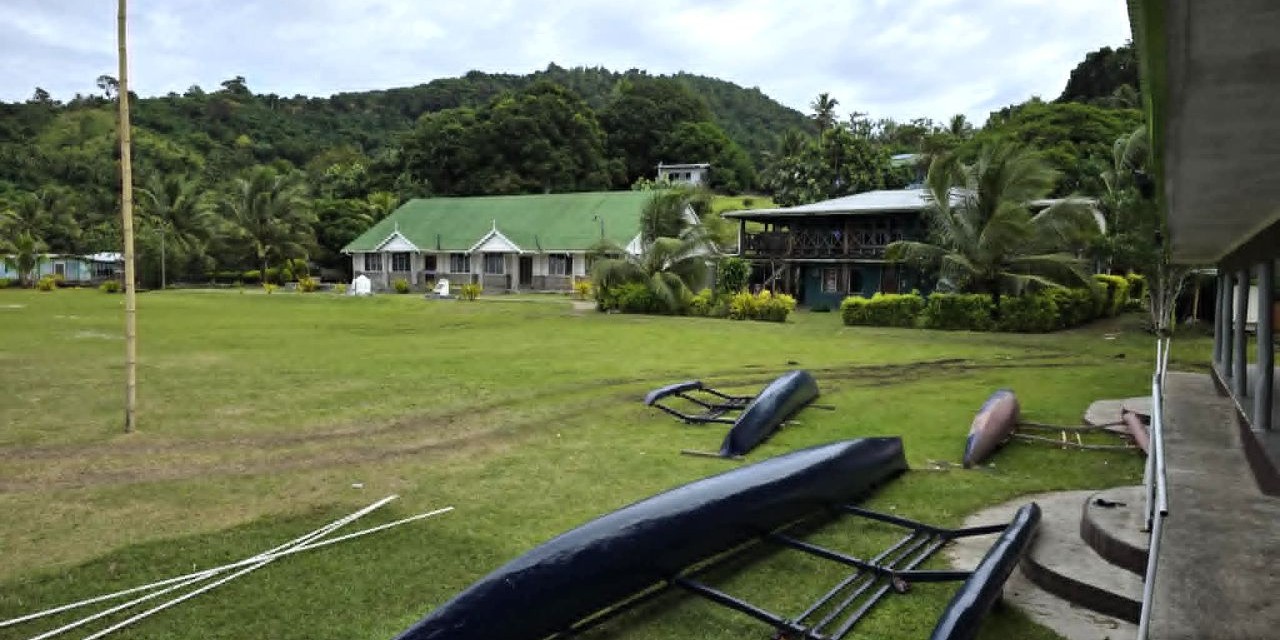
Tuvalu means ‘group of eight’, referring to the eight fenua, distinct communities each with their own island and their own customary governance system. In the 1940s, one of Tuvalu’s eight fenua, the community of Vaitupu, purchased Kioa island in the Cakaudrove Province of Fiji. The Vaitupu community negotiated with the colonial authorities to allow some of its members to move to Kioa, which was at the time uninhabited and available as freehold land, although from an Indigenous sovereignty perspective it also remained part of the Cakaudrove Province. The purchase of Kioa was an act of Indigenous foresight, creating a Vaitupuan settlement governed through the Vaitupu customary governance system, operating both in its own right and within the Cakaudrove customary governance system.
Kioa today is a proud community of Tuvaluan-speaking people. Kioa is governed by the Kioa Kaupule (Council) and the 110 Matai (traditional landowners who represent the original families who contributed to the purchase) as well as Cakaudrove governance and the national laws of Fiji. Kioan customary governance thus operates largely harmoniously within the Fijian nation-state. But it also remains culturally, linguistically, and emotionally tied to Vaitupu in particular, as well as to the Tuvaluan nation, and is subject to transnational Vaitupu–Kioa governance arrangements which determine who can access land on Kioa. Kioa is often referred to by its residents as the ninth fenua of Tuvalu. It is unique, being both part of the customary sovereignty of Vaitupu and with its own political identity and governance.