
At Norway's Newest Island Retreat, Redefining the Relationship Between Community and Tourism
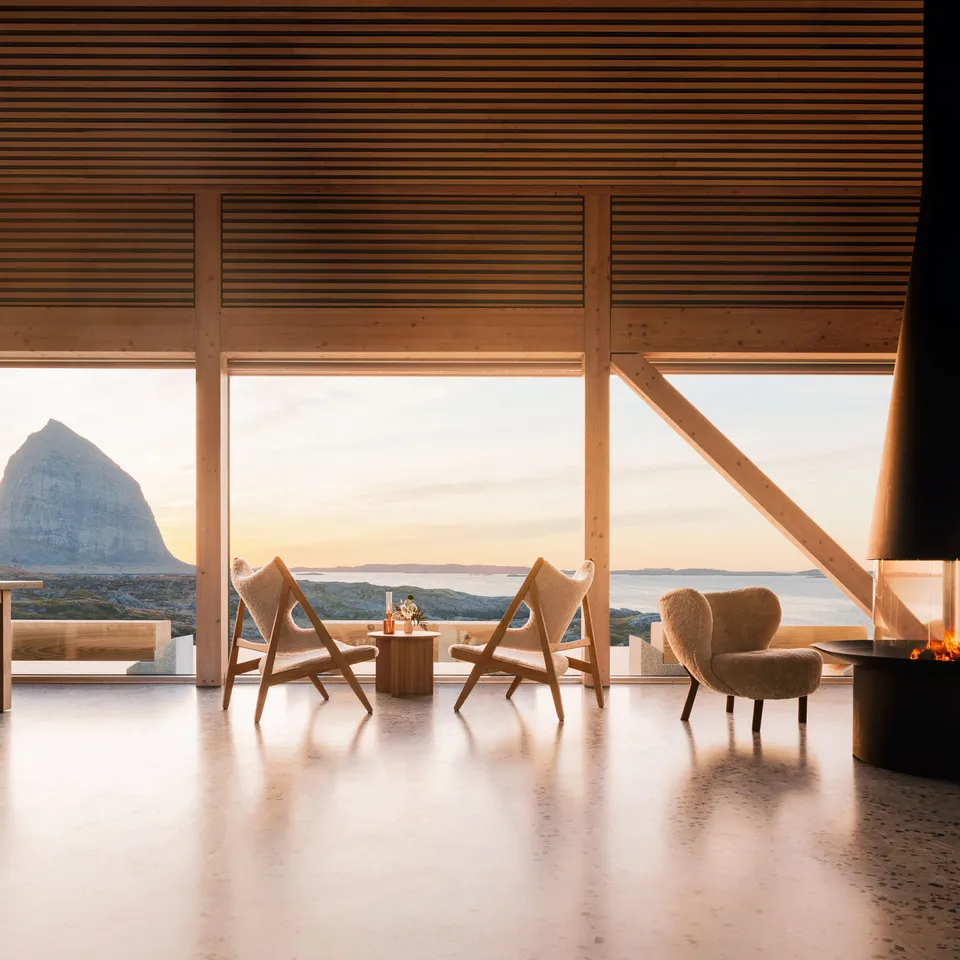
Traveling to Ytri Island Retreat—which bills itself as “Norway’s most remote island retreat,” and is a 112-mile journey by ferry from the northern coastal city of Bodø—is no small feat. It’s perched on Husøya, one of the 477 islands of the Træna archipelago enfolded by blueberry seas—no wonder that its name means “outer point.” But despite the sobering distance and tales of ferocious winter storms that have been known to blow whole buildings into the sea, I find not so much a rugged, isolated hideaway as a smart, well-oiled operation anchored in its community.
The concept of a luxury hotel was mooted by the locals a decade ago when, facing a hollowing-out of the regional fishing industry, the municipality and local development company Træna 365 gathered to brainstorm alternative futures for the archipelago. After six years of planning, investors Asle Helgheim and Ellen Hestenes—keen sailors with an existing Swedish spa hotel—came on board. Since Ytri Island Retreat opened in April, Træna’s population has increased by almost two percent—a sign that the project’s vision of social sustainability is already bedding in.
I arrive a few days out from the summer solstice, when the sun appears to move sideways across the sky and the landscape is one of repose. The spartan rocky tufts that unfold from the hotel to the sea are blanketed with moss and wildflowers, and rabbit-tailed strands of swamp wool quiver in the breeze as if they’re bursting to tell me something. Looking back from the shore at Ytri’s cluster of industrial buildings in garnet, mint, and silver—modeled after fishermen’s dwellings—I see its windows catching the golden swell of midnight sun and reflecting a gentle hammered-glass ocean uninterrupted by boats.
Inside, the 38 rooms and suites are simple, even monastic: pitched, high, church-like ceilings in pale wood; Norwegian wool cushions and blankets in inky blues and smoky grays; wonky ceramic vases blooming with dried flowers; and a bioelectric fireplace in my suite’s lounge. Design firm Bonaparte Interiør has used local materials such as a terrazzo floor made of sand, stone, and shells from the island, and there are abstract prints by Norwegian artists on the walls and pine-scented Skøn toiletries in the bathroom. But really, the invitation here is to look out. Floor-to-ceiling windows in every room—and a lava-smooth bathtub in mine—all face the emblematic shark-toothed Trænstaven mountain that rears out of the ocean on Sanna island opposite.