
From Diplomacy to Maritime Strategy: Seychelles Anchors India's Indian Ocean Vision
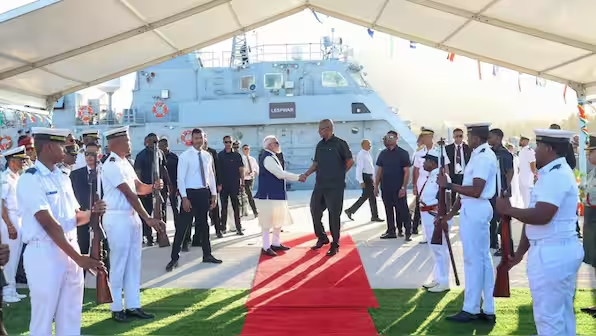
When I handled India's relations with Seychelles in 1979, the country had been independent for barely three years. India did not yet have a resident High Commission in Victoria. I had been posted to Nairobi to learn Kiswahili and was also tasked with looking after our relations with Seychelles, then concurrently accredited from Kenya.
It proved to be one of my most endearing assignments. I paid many visits to Seychelles, an Indian Ocean archipelago whose warmth, informality and Creole culture made an immediate impression. I was advised on first arrival that ties were not worn in Seychelles. Ministers and senior officials were remarkably accessible and hospitable. Conversations were informal and frank, unconstrained by protocol. It was diplomacy conducted with a degree of trust that larger capitals rarely permit.
Spread across the western Indian Ocean, the islands occupied a far larger maritime space than their land or population size would suggest. It was already evident that the security of these waters would matter greatly to India. Exchanges with the Seychellois leadership over security and maritime cooperation reinforced the case for opening our High Commission in Victoria. The mission had to be built from scratch. When I called on the President's Secretary to say the mission was functional, he took me straight to the President, who was delighted by the news. On learning I had spent twenty-one days in Victoria, he joked that no Indian official had ever stayed in Seychelles so long. Neither of us could have imagined then how central Seychelles would become to India's Indian Ocean strategy.
Nearly five decades later that judgement stands amply vindicated. Much commentary today on our Indian Ocean policy focuses on major powers, naval deployments and geopolitical competition. Yet a more important transformations occurred away from those headlines. Small island countries, once regarded mainly as development partners, are also now indispensable strategic partners. For India, Seychelles illustrates that evolution better than almost any country.
The relationship has developed in the familiar mould of post-colonial cooperation. India extended Lines of Credit, trained officials, supported infrastructure projects and responded to urgent needs, whether in healthcare, food security or capacity-building. Over the decades, thousands of Seychellois received professional training in India, while Indian support covered transport, digital infrastructure, renewable energy and community development.
Besides growing development linkages, maritime security has gradually moved from the margins to the centre of our partnership. India's support expanded from training programmes and equipment to maritime surveillance, hydrography, coastal radar networks, patrol vessels and aircraft. Joint exercises became more sophisticated. Intelligence sharing deepened. Indian and Seychellois institutions now work together in ways difficult to imagine when our relationship began. The evolution has been from donor-recipient to operational partners.
That transformation reflects changes in the Indian Ocean itself. Piracy, narcotics trafficking, illegal fishing, maritime terrorism and climate-related disasters do not respect national boundaries. No country can address such challenges alone. Security increasingly depends on networks of trusted partners rather than individual national capabilities.
Seychelles has also helped reshape thinking about the oceans. Alongside the label of Small Island Developing State, it championed the idea of Large Ocean States. The term captures an important reality: a country with little land may nevertheless exercise responsibility over an enormous maritime domain rich in biodiversity, fisheries and strategic sea lanes. Its influence derives not from land alone but from stewardship of the oceans.
India's own maritime outlook has similarly evolved. The Indian Ocean is no longer simply one theatre among many. It is the region where India's contribution to stability, maritime security and the blue economy will increasingly focus. Partnerships with Seychelles, Maldives, Mauritius, Comoros and other island states are not peripheral to our foreign policy; they are central to it.