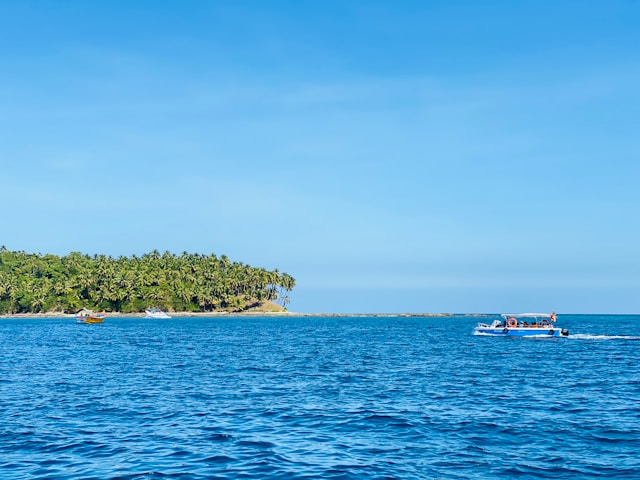
The Indian government, which inherited Great Nicobar Island from British colonizers, is about to build a massive transshipment terminal there. Described as a new Hong Kong, the $9-billion free-trade zone is to include a port with an eventual capacity to handle 16 million cargo containers a year, a town for 350,000 people resettled from mainland India, ancillary industries, a power plant and an international airport to be used by 4,000 peak-hour passengers.
The project will fell close to a million primeval rainforest trees in its initial phase alone and ultimately spread over 244 square kilometers—nearly a fifth of Great Nicobar. It’s not only the Shompen who will be devastated. The island is also home to the Great Nicobarese, an Indigenous people who lived mainly along the southern and western coast until the massive tsunami of 2004 washed most of them away. The survivors were evacuated to the eastern coast, where they reunited with compatriots who returned from studying or visiting elsewhere. The Great Nicobarese have long pleaded with the Indian government to be allowed to return to their ancestral lands. But these are to be subsumed by facilities associated with the complex.
Great Nicobar is a also a UNESCO biosphere reserve and part of the Sundaland biodiversity hotspot, a region whose extraordinary biodiversity inspired the evolution theory of Alfred Russel Wallace, Charles Darwin’s great rival. Of the more than 2,500 species of fauna and flora thus far documented on the island, 17 percent are endemic—found only on Great Nicobar or sometimes also on the other, far smaller, islands of the Nicobar archipelago.
Environmentalists have warned that the clear-cutting, blasting, dredging, construction, dumping of debris, ship traffic, pollution of multiple kinds and the enormous influx of outsiders with their animals and germs will devastate the Indigenous people and the creatures who live on and around Great Nicobar.