
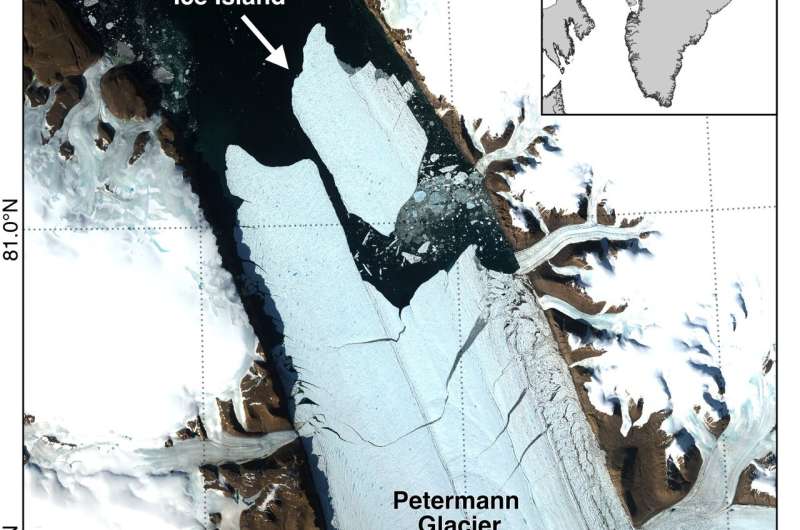
An international research team partly led by the University of Ottawa reports that Petermann Glacier in northwest Greenland calved a 76.4 km² (29.5 square miles) ice island on Aug. 4, 2026, marking the glacier's largest loss of floating ice since 2012 and the largest Arctic calving event since 2020.
The newly formed tabular iceberg detached from the glacier's floating ice tongue and is estimated to be up to 150 meters (492 feet) thick. With a surface area roughly comparable to Manhattan Island, the ice island offers scientists a rare opportunity to study how large Arctic ice masses form, drift and break apart over time.
The event was detected by Adam Garbo, a doctoral student in glaciology at uOttawa's Department of Geography, Environment and Geomatics, as part of ongoing collaborations among the University of Ottawa, the University of Stirling, Environment and Climate Change Canada, Lancaster University and the University of Leeds.
Years of monitoring helped researchers anticipate the break
The calving event was detected through long-term satellite monitoring that has tracked changes at Petermann Glacier since 2019. Researchers have been following the glacier's floating ice tongue, documenting the growth of fractures and monitoring signs of instability over several years.
"Petermann Glacier has long been one of Greenland's largest remaining ice tongues," says Garbo. "We've anticipated this break for years, and seeing it finally happen is remarkable."
Satellite imagery from the European Space Agency's Sentinel-1 mission showed clear deterioration along the centerline of the ice tongue on Aug. 3. By 20:00 UTC on Aug. 4, the new ice island had detached from the eastern side of the glacier.