
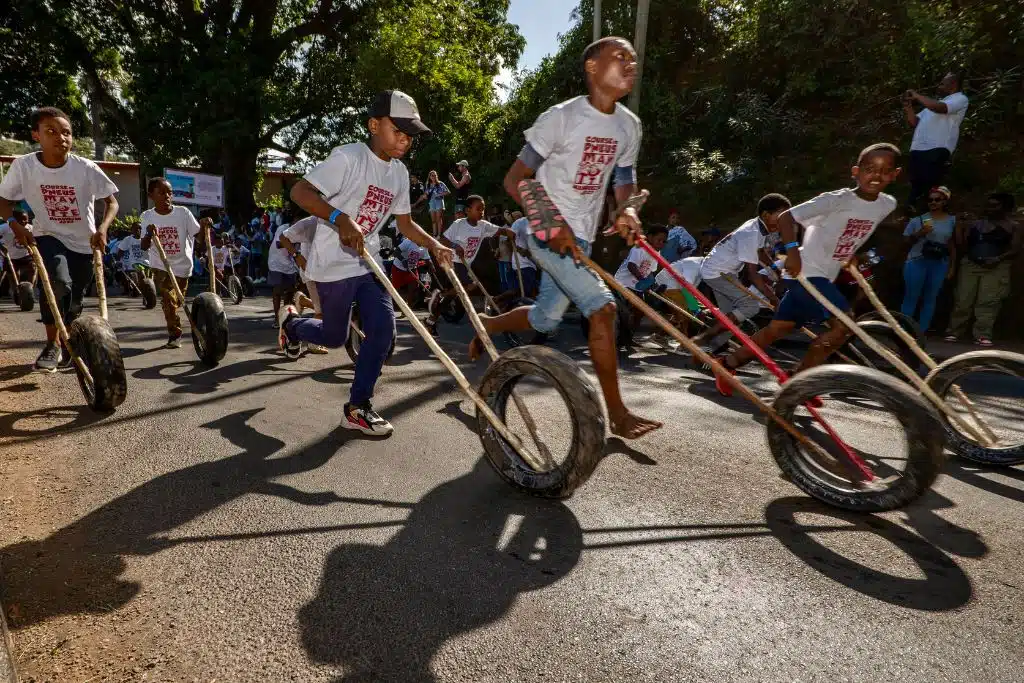
In Mayotte, an archipelago in the Indian Ocean between Madagascar and the coast of Mozambique, a tire race tells the story of a world struggling with its waste. On the roads of Mayotte, an abandoned tire is never just an object. It is a piece of rubber that has reached the end of its life in a place where no system exists to take it back. A silent witness to the difficulties faced by island territories that must handle waste they did not produce, yet are forced to manage. In 1984, a physical education teacher, Jack Passe, decided to turn this reality into something positive. Drawing from a traditional Mahoran game in which children roll a tire using two sticks, he created the island's first "tire race". What began as a playful school activity soon became a cultural and athletic tradition, showing how local ingenuity can flourish where industrial solutions remain absent. The race demonstrates how communities can reclaim a problem and turn it into a moment of collective energy. Every tire recovered for training or competition is one less tire abandoned in the environment. But beyond the creativity hides a far more complex challenge underpinning the island's daily reality. Despite continuous efforts, Mayotte still faces structural constraints in managing used tires. Storage capacity is limited. Exporting waste for treatment is expensive in a territory where all recycling must happen elsewhere. Collection schedules vary across municipalities, and in certain areas, tires continue to appear in informal dumps. When filled with rainwater, they become breeding grounds for mosquitoes and contribute to the spread of disease. When burned, they release toxic smoke that contaminates soils and air. The tire race is a creative and symbolic response, but it does not resolve the underlying issue. Instead, it highlights a broader reality: island territories must manage objects designed and produced elsewhere, without meaningful support from the companies responsible for putting these products on the market.