
It started six years ago when Shaha Hashim began seeing posts across social media: Vulnerable and protected species were being fished throughout the atoll islands of the Maldives, and some were even turning up in fish markets.
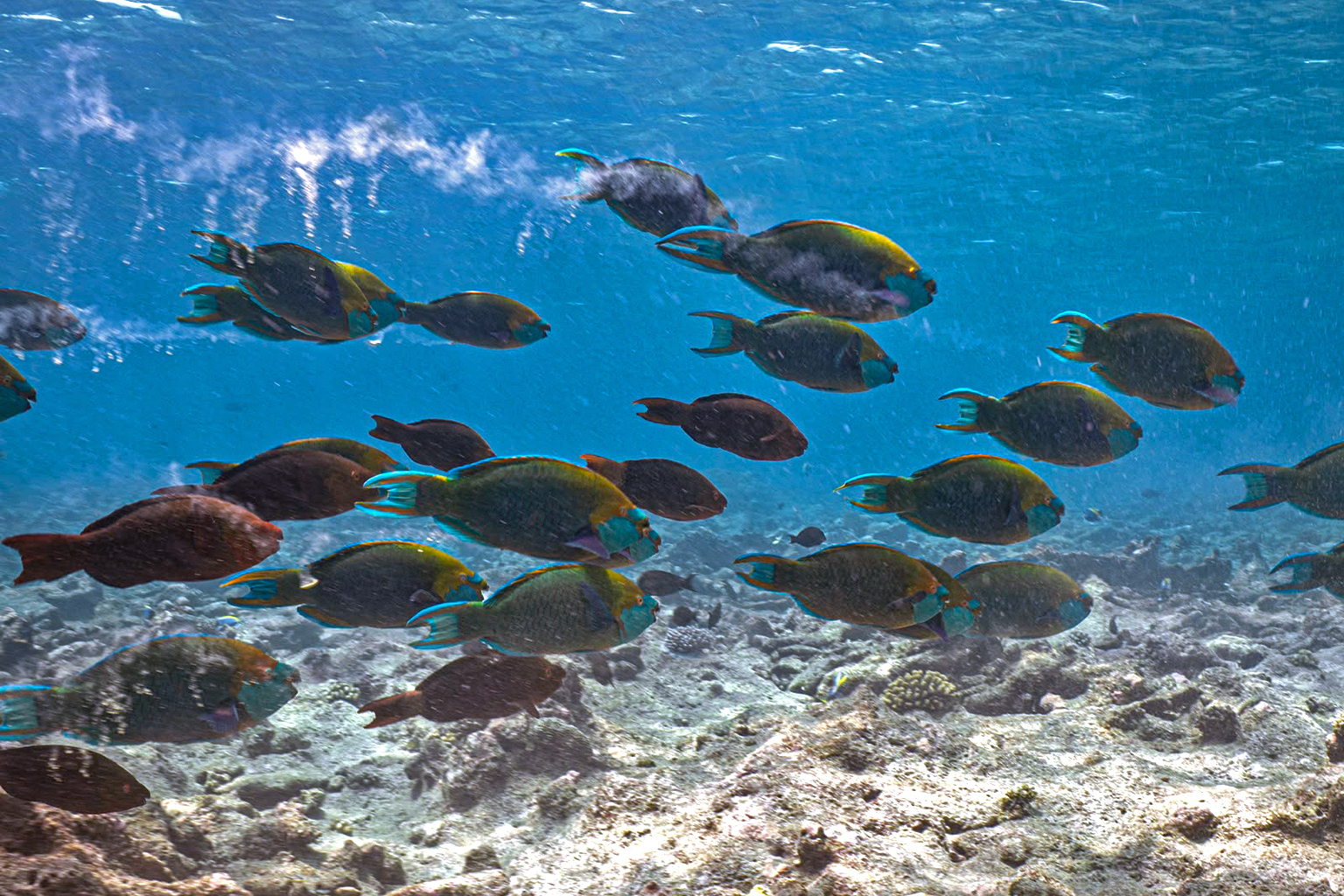
This included animals like the giant clam (genus Tridacna), Napoleon wrasse (Cheilinus undulatus), and even species of parrotfish (subfamily Scarinae).
These species weren’t historically targeted by Maldivian fishers, but were rising in popularity over the last decade. This came to a head in the midst of the COVID-19 pandemic, as tourism workers were being let go from their jobs at resorts, and fishing became more popular recreationally, as well as a means of earning money and providing food.
“This was the only way for them to earn an income at that time,” Hashim told Mongabay by video call. Today, she’s the co-founder and executive director of Maldives Resilient Reefs (MRR).
Hashim said the parrotfish were particularly concerning. At the time, they weren’t a protected species, though they played a key role in recycling sediment and generating new habitat for coral reefs. Protecting them means safeguarding accretion: An important sedimentary process that is intertwined with the resiliency and natural management of atolls.
“Accretion really is the deposition of sediment above the water level,” said Paul Kench, a coastal scientist and the pro vice-chancellor of Te Wānanga Pūtaiao Division of STEM at the University of Waikato in New Zealand. He told Mongabay by video call that accretion allows atolls to naturally combat climate change by rising with the sea level and growing horizontally.
Parrotfish help in multiple ways
In 2015, Kench co-authored a paper that found parrotfish responsible for generating upwards of 85% of the new sand-grade sediment produced in outer reefs surrounding reef islands.
They use their beak-like teeth to grind through coral exoskeletons to get to the algae — or sometimes the soft, living coral polyps — inside. They then excrete any ingested coral chunks as fine sand It’s one of many ways sediment can be generated and make its way to islands, in order for accretion to take place.
A study published in the journal Geology in 2015 found that parrotfish were responsible for producing upwards of 85% of sand in the outer reefs surrounding the islands of the Maldives. Beyond generating sediment, parrotfish contribute to reef expansion by eating algae off of prime surfaces where baby coral called planulas can anchor and grow.
Coral reefs are ultimately sediment factories, said Sebastian Steibl, a postdoctoral researcher at the University of Auckland and the Naturalis Biodiversity Center in the Netherlands. He has studied Maldivian coastal ecosystems for the last decade. He told Mongabay by video call that when it comes to these ecosystems, protecting biodiversity and sedimentary processes are intertwined. “It comes in a package,” Steibl said.
#FishForTomorrow campaign is a success
With the Blue Marine Foundation, MRR launched an educational campaign over social media: #FishForTomorrow. Their goal was to broadcast information about the important ecological roles of the different species that were starting to show up in markets. They posted facts about parrotfish life spans, the amount of sediment they produce, and how they help make room for baby coral.
The community campaign went viral on social media, Hashim told Mongabay. Community members began posting videos with the hashtag of them releasing parrotfish that accidentally ended up on their lines; local scientists spoke out in support of the campaign; fishers began reaching out to Hashim’s NGO to thank them for their work. An online poll from MRR garnered 27,000 responses in the final days of the four-week campaign: Around 70% of responders supported the legal protection of parrotfish.
“It was really exciting to see that other people were appreciating what we were trying to do, and they were willing to join for free, voluntarily,” Hashim said.