
In 1944, 29 Reindeer Were Left on a Remote Island in Alaska, Decades Later, They Had Eaten Themselves Into Extinction
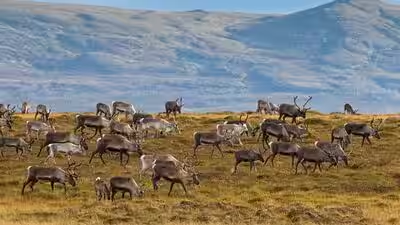
What happened to the reindeer on St. Matthew Island is a classic story of wildlife boom and bust. In 1944, the US Coast Guard corralled 29 Nunivak Island reindeer on a barge and floated the animals north to the island, more than 200 miles away to one of the most remote places in Alaska. While they initially grew into a population across the land, today the island is devoid of any reindeer, according to a report by AS.
A food source
The Coast Guard had earlier in the year placed a radio navigation system on the island, along with 19 men. St. Matthew Island is a narrow strip of tundra in the Bering Sea, more than 200 miles from the nearest village. The reindeer were intended as a roaming food source should the men be cut off from supply shipments. The men never shot a single reindeer; the Allies were winning the war, and the Coast Guard pulled its men from the island. But they left the reindeer.
Initially, the situation was fine for the animals. Their only predators had disappeared, leaving them on a 32-mile-long, four-mile-wide island rich with their favourite food, lichen.
Biologist Dave Klein first stepped on the island in 1957, 13 years after the Coast Guard had abandoned it.
Klein, 82, now a professor emeritus for the Univerisity of Alaska Fairbanks' Institute of Arctic Biology, hiked the length of the island with field assistant Jim Whisenhant in 1957. They noted that the herd of 29 reindeer had increased to more than 1,300 animals.
Klein returned to the hard-to-reach island six years later. He could hardly believe how many reindeer were there. "We counted 6,000 of them," Klein said in a 2003 interview. "They were really hammering the lichens."
But the scene, with its 47 reindeer per square mile, foreshadowed a crash ahead that no one was able to predict. They had trampled vegetation and consumed much of the food that had allowed their extraordinary expansion. The island could accommodate a population boom. It could not keep feeding one forever. For the unversed, a reindeer are large deer that live in the Arctic and sub-Arctic regions of Europe, Asia, and North America. In North America, they are commonly called caribou.
They are well adapted to extremely cold environments, with thick fur, broad hooves and a layer of body fat that helps them survive harsh winters. Unlike most deer species, both male and female reindeer can grow antlers, although males generally have larger ones.
Out of sight
When Klein returned to the island in the summer of 1966, three years since his last visit, the herd of 6,000 had shrunk to a shocking 42. This number included only one male that had abnormal antlers and was probably unable to reproduce. There were no fawns.
Moreover, reindeer skeletons littered the entire island. The herd had busted. During the next decade or so, all the reindeer of St. Matthew Island died off. According to the US Geological Survey, the last female died in 1981.
According to Klein, an extreme winter might have forced the stressed population to the brink.