
Construction underway on a remote island nearly 400 kilometers west of India’s mainland could demonstrate, for the first time, the commercial viability of a vast, untapped renewable resource: the ocean’s thermal layers. Here, on the Lakshadweep Archipelago, surface waters are more than 20 °C warmer than the depths below, and with the right equipment that temperature differential can be exploited to generate electricity.
Known as ocean thermal energy conversion, or OTEC, such power plants can deliver renewable power around the clock. The scale of the opportunity is immense thanks to extensive regions of the world’s oceans with sufficiently large temperature differences between surface and deep waters. In just the waters around the United States, for example, OTEC could satisfy the country’s entire power demand, according to a 2021 report by the U.S. Department of Energy’s National Laboratory of the Rockies.
India’s project will tap 1,000-meter-deep seawater to generate 65 kilowatts of electricity and produce 100,000 liters of potable water per day. Developed by India’s National Institute of Ocean Technology (NIOT), it’s a small project, but a big step toward a commercial breakthrough for OTEC. “What we are doing is scalable in numbers for islands and remote communities. This can be a market strategy,” says Purnima Jalihal, who led the project before retiring last year as head of the energy and freshwater division at NIOT.
The project is part of a fresh wave of enthusiasm behind OTEC. Kilowatt-scale projects have been completed recently in China and the Canary Islands, and more are planned for Hawaii, Taiwan, and Japan. While previous efforts to commercialize OTEC have come up short amidst engineering snafus, efficiency shortfalls, and funding constraints, today’s efforts benefit from advances in key devices and engineering capacity.
Still, far bigger projects are needed before investment in OTEC will take off, says Robert Varley, who led defense contractor Lockheed Martin’s OTEC program from 2006 to 2017. Most OTEC proponents agree, saying the field needs a demonstration of at least a few megawatts, which is an order of magnitude larger than the longest-running projects to date. “Once that happens, I think the world changes for OTEC,” Varley says.
How Ocean Thermal Energy Conversion Works
Earth’s oceans absorb much of the sun’s daily irradiation and excess heat trapped in Earth’s atmosphere. But most of this thermal energy stays within 100 meters of the ocean’s surface. The deep seas remain frigid, dominated by meltwater from Earth’s frozen poles.
Since the 1970s, a few dozen projects have sought to harness that heterogeneity. It’s challenging because the temperature gap the technology aims to exploit is relatively narrow. Even in tropical zones, most OTEC plants will have to make do with a 25 °C difference between the surface waters and the cold waters 1,000 meters below. (By contrast, conventional thermal generators function off of a 400 °C temperature spread.)
To harness the small temperature differential, most groups generate power by heating and cooling a working fluid that naturally boils at a low temperature, such as ammonia. Surface water is pumped into the plant, and its heat is transferred to the ammonia, causing it to evaporate. That vapor then drives a turbine to generate power. Finally, to repeat the cycle, the ammonia’s heat is transferred to cold water piped in from the deep, causing the ammonia to condense.
Squeezing power from a meager temperature delta requires a lot of surface and deep water. A 6.4-MW OTEC plant proposed on Taiwan’s east coast by Taipei-based industrial conglomerate TCC Group Holdings would suck up to 9,500 liters of cold seawater per second from 600 meters below the surface. A 10-MW design Lockheed envisioned for installation in China in 2013 would have processed 40,000 liters of seawater per second, but it was never built.
Pumping on that scale favors placing plants on offshore platforms, which shortens the pipes required since they can extend straight down to reach lower depths. But offshore platforms increase costs, and operating in punishing open ocean conditions increases risk. When filled with water, an offshore OTEC platform’s dangling cold water pipe will weigh tens of thousands of metric tons, and any movement from rough seas will place immense stress on its connection to the platform.
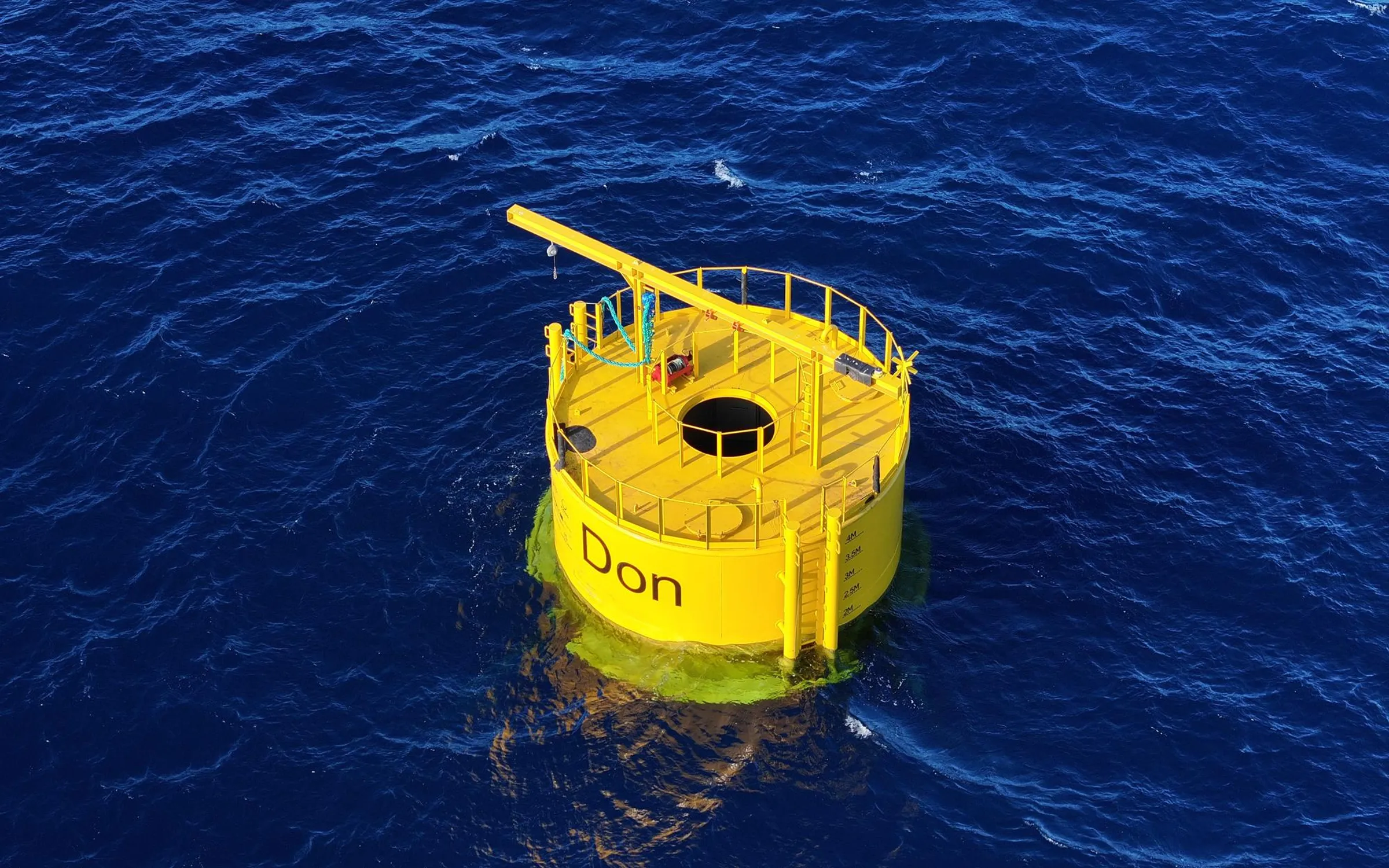
To address one of the risks of being located offshore, London-based startup Global OTEC deployed in the Canary Islands the world’s first platform purpose-built for OTEC and hurricane readiness. The platform, floated in April and paid for by government grants, is a 1:7-scale, non-working model of a 2.5-MW demonstration plant.
An operating plant will be required to convince investors of the technology’s reliability. Jacobus, Pennsylvania-based Sea Solar Power, established in 1972 to pursue OTEC, is designing a 25-MW plant that it vows would satisfy investors by paying for itself if its electricity serves an island grid reliant on expensive diesel power. Sea Solar president James H. Anderson Jr. says his firm survived to date thanks to revenues from its manufacturing spinoffs, but he says the company is now seeking a US $5–10 million investment to finish the plant’s “pre-feasibility” engineering design. Building the plant would cost at least US $120 million more.