
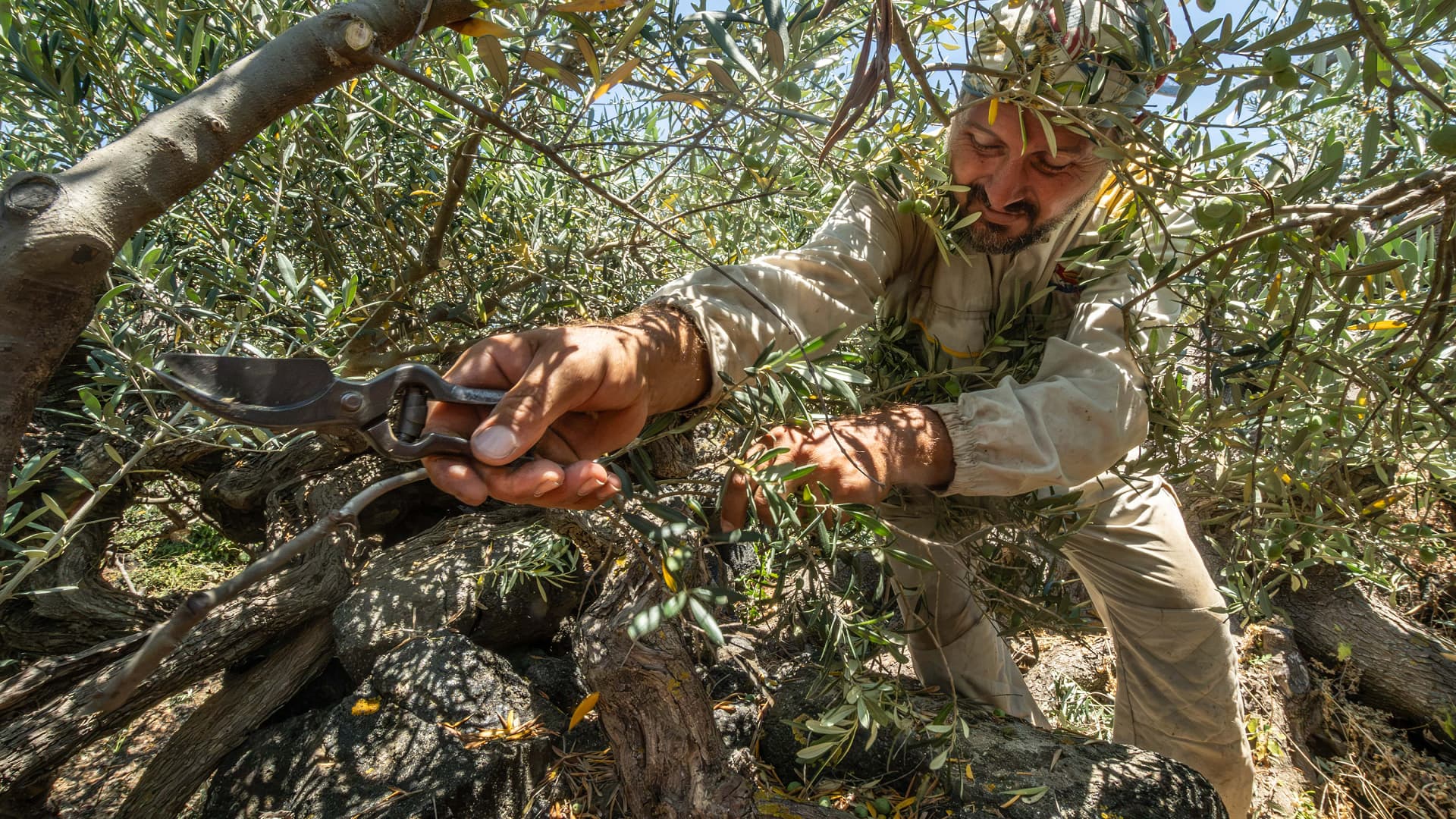
The Circular Ecosystems of Cooperating Communities (EcCiCoCò) project has launched on the Italian island of Pantelleria, led by the Resilea association. The initiative aims to safeguard the island’s ancient olive trees while creating a community-based social enterprise built around a circular economy model for managing olive-growing and milling byproducts.
"The more hostile the environment, the more the plant develops intrinsic adaptive capabilities and increases the production of these highly specific metabolites." –Elena Sgaravatti, PlantaRei Biotech chief executive
The EcCiCoCò project aims to repurpose more than 250 tons of olive oil byproducts, including pomace, pits and pruning waste, which until now have been almost entirely shipped off the island, located southwest of Sicily.
The program includes transforming pomace into compost and converting olive pits into pellets for domestic use.
A multifunctional biotech laboratory will support small local producers in developing plant-based wellness products, while a scientific research group will work to extract polyphenols from olive leaves for cosmetic and nutraceutical applications.
The project is expected to create five jobs, with priority given to people who have been unemployed for long periods.
“The first step will be to make good and effective use of the pomace produced by the Pantelleria mill, which until now has been shipped off the island at considerable financial and environmental cost,” Gianpaolo Rampini, president of Resilea, told Olive Oil Times.
“After speaking with Antonio Motisi of the Department of Agricultural, Food and Forest Sciences at the University of Palermo, who coordinated our previous project, and with agricultural expert Leonardo Cannata, we decided to convert the pomace into compost and to establish a composting center here on the island,” he added.
“Since pomace generally cannot compost on its own, we reached out to the Pantelleria National Park, which produces between 200 and 300 cubic meters of forestry cuttings each year,” Rampini said.
“We also contacted the Municipality of Pantelleria, whose green-space trimmings were also transported to Sicily for disposal, with substantial financial and environmental impact, and we invited both institutions to join our effort,” he added. “We then proposed a co-financing arrangement to Fondazione con il Sud, which enabled the project to move forward.”
On Pantelleria, a volcanic island and one of Italy’s southernmost territories, olive trees are cultivated through a unique system that induces their horizontal growth. Growers use a pruning technique that excludes return cuts and train the branches by anchoring them to the ground.
The method produces distinctive low-growing, or prostrate, olive trees that remain below the height of nearby dry-stone walls. The resulting microclimate helps the trees conserve water and withstand strong winds and other extreme weather conditions.
Resilea, whose mission includes rebuilding and strengthening communities, has begun collaborating with the University of Palermo to preserve and share knowledge of this sustainable, climate-resilient form of olive farming.
The practice has supported olive cultivation and oil production on Pantelleria for centuries but now risks disappearing because of a lack of generational renewal.
The knowledge-sharing initiative, which brings together students and elderly growers, has generated enthusiasm and helped pave the way for broader participation in the EcCiCoCò project.
The initiative is expected to run for four years, with the first 18 months focused primarily on establishing the community enterprise.
Among the organizations involved is PlantaRei Biotech, an innovative small and medium-sized enterprise focused on high-value agri-food byproducts. Over the past three years, the company has studied leaves from Pantelleria’s low-growing olive trees to extract polyphenols.
Funded by the University of Bologna under the Ecosister program, the REPARAPOLI research project aims to valorize pruning residues – in this case olive leaves – from centuries-old trees grown in Pantelleria’s extreme environment.
The goal is to transform the material into functional ingredients for cosmetics and nutraceuticals using low-impact processes.
Based on circular economy principles and biodiversity enhancement, the research uses a low-impact green chemistry approach.
After collecting and processing the leaves, researchers extract polyphenols using environmentally friendly solvents, ultrasound, microwaves and lytic enzymes. The broader aim is to turn agricultural waste into useful products while making local agriculture more sustainable and economically viable.
“This island of volcanic origin subjects its centuries-old olive trees to environmental pressures that shape a distinctive secondary metabolism,” said PlantaRei Biotech chief executive Elena Sgaravatti.
“Prolonged water stress due to low rainfall and minimal irrigation, constant wind, and intense UV radiation all contribute to this response,” she added. “It is well known that plants exposed to these extreme conditions produce secondary metabolites essential for their survival.”
“My first experience with this kind of study was with Edelweiss (Leontopodium nivale subsp. Alpinum), which is also exposed to severe environmental stress on high mountains,” Sgaravatti said.
“Secondary metabolites have evolved to help the plant withstand external conditions,” she added. “Plants communicate with one another and defend themselves through these compounds, which form a large family that includes polyphenols, tannins, flavonoids, and more. The principle is that the more hostile the environment, the more the plant develops intrinsic adaptive capabilities and increases the production of these highly specific metabolites.”
Sgaravatti said up to 2,500 kilograms of olive leaves can be recovered from a one-hectare grove after pruning. According to the research, researchers can recover about 375 kilograms of leaves from 1,500 kilograms of pruning waste and use them to extract secondary metabolites.