
Renewable Energy Powering Shoals Marine Laboratory Could Be Blueprint for the Future
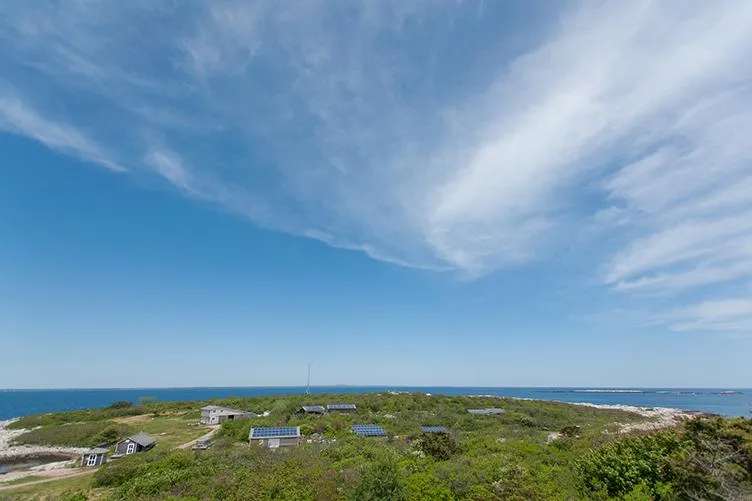
At Shoals Marine Laboratory, jointly operated by UNH and Cornell University on Appledore Island, sustainability has been a way of life for 20 years. This story, reprinted with permission from the Union Leader, the state's largest daily newspaper, details how the lab's green power microgrid has helped reduce reliance on diesel fuels by 98% — and is a proof of concept for renewable energy anywhere.
Wondering what the future of renewable, sustainable energy might look like in New Hampshire? The answer may just lie about 6 miles offshore in the Gulf of Maine — no crystal ball needed.
Look no further than Appledore Island, home to the Shoals Marine Laboratory (SML), marking its 60th anniversary this year. Operated by the University of New Hampshire and Cornell University, the 95-acre island isn’t connected to the electricity grid that exists on the mainland, and engineers have worked to build an innovative green power microgrid that runs on renewable energy.
And now, they’re ready to show it off to the world.
“Shoals Marine Lab’s green grid has got to be 20 years ahead of anybody else. It’s truly incredible,” said Tom Greene, a UNH Marine Docent — a group of volunteers who help connect the public with coastal research happening at Shoals.
From the solar panels to a wind turbine, the green grid provides electricity that powers research, computers, phones, lights and the dining hall — everything needed to keep the operation running.
Throw in other sustainable operations such as compostable toilets, recycling, kitchen composting and collecting rainwater for use in the famous Celia Thaxter Garden and those familiar with the site say the day-to-day operations on Appledore are decades ahead of similar efforts elsewhere in New Hampshire.
On Tuesday, a Union Leader reporter and photographer were among 29 people to take part in the inaugural, day-long Shoals Sustainability Tour, developed in response to growing interest in green living.
Participants on the sold-out trip spent the day alongside SML’s engineering and sustainability staff learning how the island campus produces and manages its own power, water and waste while serving hundreds of students, researchers and visitors each year.
“We’ve been living sustainably and have this great, amazing green grid on the island for like the last 20 years and we had to have it that way in order to have our students out there. But it’s become such a topic of public interest that we decided to do a pilot tour last summer and test what it would be like to actually focus a full day on our green grid and sustainable infrastructure. You guys are the first real, live public program that we’ve had,” said Amy Fish, SML’s director of community relations.
About 65 people live on Appledore Island in the summer, all of them connected in some way to the lab. No one is onsite during the winter months.
Until the mid-2000s, SML was powered exclusively by diesel generators. If the generators went down, the lights went out. By 2006, SML was consuming more than 10,000 gallons of diesel per year.
Since then, through implementation of green energy solutions and dedication to energy savings, SML has reduced its diesel fuel consumption by 98%.
Last year, the lab’s generators, which operate using solar power with diesel as a backup, used just 170 gallons of diesel for the entire four-month season (May through August), compared with using 9,361 gallons of diesel prior to the installation of solar panels in 2007, when the generators ran the island.
Conserving energy and water
The energy conservation building, constructed in 2014, is home to the main battery bank for the island’s green energy microgrid, storing solar and wind power to distribute electricity to 14 buildings.
Energy is stored when the sun is shining and the wind is blowing, for use when clouds roll in for any extended period of time.
“On a day where it’s completely cloudy, I literally will make an announcement in lunch and say, ‘What do you see outside?’” said Sara Morris, executive director of SML. “And the students get to know very quickly — clouds. What does that mean? Turn everything off that we possibly can. What this means is that the students see a sense of responsibility and they can see that they can make a difference in the environment.”
Potable water is an important but finite resource on the island. A reverse osmosis machine that produces fresh water is “a big energy draw,” which is why it makes sense to run it when there’s excess energy being generated, according to Alec O’Meara, director of external affairs at Unitil, which helps with the design and maintenance of SML’s microgrid.
“If you’re running it in the afternoon, while you’re able to get all the solar energy you need to charge the batteries at max and run the lab completely, they still have surplus energy at that time — energy that they couldn’t do anything with otherwise,” O’Meara said. “So, by running this (reverse osmosis machine) and generating the water at that moment, they’re able to maximize that use. If they’re doing it any other time, they’re going to be using energy that otherwise would have been stored, right?
“That’s time-of-use energy. Utilities create things like time-of-use rates to try and incentivize exactly what this is doing in real time out here, use energy when it is most abundant.”
Tanner Burns, a lead engineer at SML, said conserving water on site is “extremely important.”
“The biggest way we do that is through our usage,” Burns said. “We limit the amount of showers we take. So, everybody on the island, staff and students, are permitted two Navy showers a week. A Navy shower is, turn the water on, you get wet, turn it off, soap yourself up, you rinse yourself, you get out. So, we try to keep it really brief.”
Through efforts like this, SML has reduced the amount of water needed for bathrooms, from 1½ gallons to 6 ounces. The island also has composting toilets.
“Prior to these composting toilets, we had an overboard discharge permit,” Burns said. “We actually had a treatment set up on island that we were able to actually treat solid waste, and have an overboard discharge permit where we would actually pump that treated waste into the ocean.”
Harnessing wind without killing birds
Walking by the 80-foot, 10 kW Bergey Excel wind turbine on the island, it’s easy to miss the fact that one of the three blades is black.
Fish said the darker color helps deter birds from hitting the turbine and killing them.
“In the whole time that we’ve had the turbine installed, we have yet to have one bird be killed by the wind turbine,” Fish said. “Safe to say that it’s very effective in keeping birds away.”