
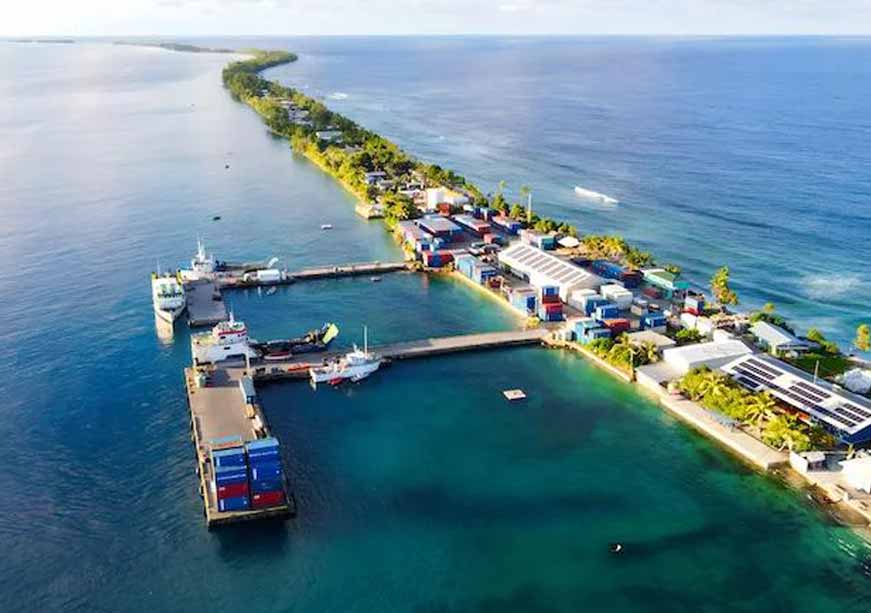
Continental maritime doctrine treats ports as gateways to inland markets, but for islands the ocean itself is the hinterland, making reliable connectivity a domestic necessity rather than an infrastructure question alone.
Continental economies see a port as a gateway to inland markets. Island communities experience the same port as a gateway to everyday life. The distinction is fundamental. A delayed vessel may cost a continental business part of its profit margin. For an island community, a delayed vessel can interrupt access to food, medicine and other essentials. This reality should shape how governments and financiers think about maritime investment.
Small island developing states (SIDS) already carry that cost in the data: the United Nations Conference on Trade and Development's (UNCTAD) 2024 Review of Maritime Transport puts SIDS' shipping connectivity at more than ten times lower than that of the rest of the world, and their maritime transport costs at 9.8 percent of the value of what they import, against 8.1 percent for developed economies and 13.7 percent for the Least Developed Countries.
The Continental Assumption
Much of the doctrine that governs maritime policy was written for continents. The organising image is a chain that runs from farm and factory through road and rail to the quayside, and from there to the world. Europe's North Sea–Rhine–Mediterranean corridor shows the doctrine at full scale: some 12,150 kilometres of railway, 5,000 kilometres of road and 5,030 kilometres of inland waterway carry cargo from the ports of Rotterdam, Antwerp and Genoa to industrial regions as far inland as Switzerland and southern Germany. In that model, the port is a terminal whose value lies in how efficiently it moves cargo between land and sea. Measures such as throughput, dwell time and corridor capacity reflect that function. The logic is sound, and for large land economies it remains the right one. It is also incomplete, because it assumes there must be a hinterland behind the port.
When the Ocean Is the Hinterland
On a continent, the hinterland is the landmass a port serves and draws upon; for an island, there is no landmass behind the port—the sea itself performs that role. The sea itself performs the role a hinterland fills elsewhere. It is the medium through which food security, healthcare access, education, labour mobility, business supply and emergency response all travel. That dependence shows up in the numbers: UNCTAD finds that SIDS have lower shipping connectivity than any other country group, and that their import transport costs run, on average, two percentage points above the global rate of 8.1 percent, reaching 20.2 percent in Comoros, 17.9 percent in Seychelles and 17.4 percent in the Solomon Islands. Maritime connectivity, in other words, links an island society to itself before it links it to the world.
The effect is clearest when something fails. When a motorway closes on a continent, traffic reroutes, and the network absorbs the loss. When a scheduled ferry or coastal service is cancelled, alternative routes are often unavailable, leaving goods stranded, patients delayed, and businesses reliant on the next sailing. Connectivity is then experienced less as logistics than as the tempo of ordinary life. Fuel-price shocks that swept the Pacific in 2022 make the pattern concrete: families in Fiji pulled children out of school because they could no longer afford the boat fare home, health workers on some islands cut prenatal check-ups back to a single monthly visit, and in Palau, shipping a single truck from Asia once cost US$30,000, enough to scrap the purchase.
This is why UNCTAD describes maritime transport as the lifeline of SIDS, underpinning trade, tourism and fisheries alike, and why remoteness and transport costs weigh so heavily on them. It is also why a growing number of these states have begun to reject the label of smallness altogether. Many have adopted the language of “Large Ocean States”, emphasising that the ocean, rather than their landmass, constitutes the overwhelming majority of their sovereign space. For these states, the ocean is not merely the space surrounding their islands; it is the territory through which communities are connected. Connectivity across it is therefore a domestic priority before it becomes an international one.