
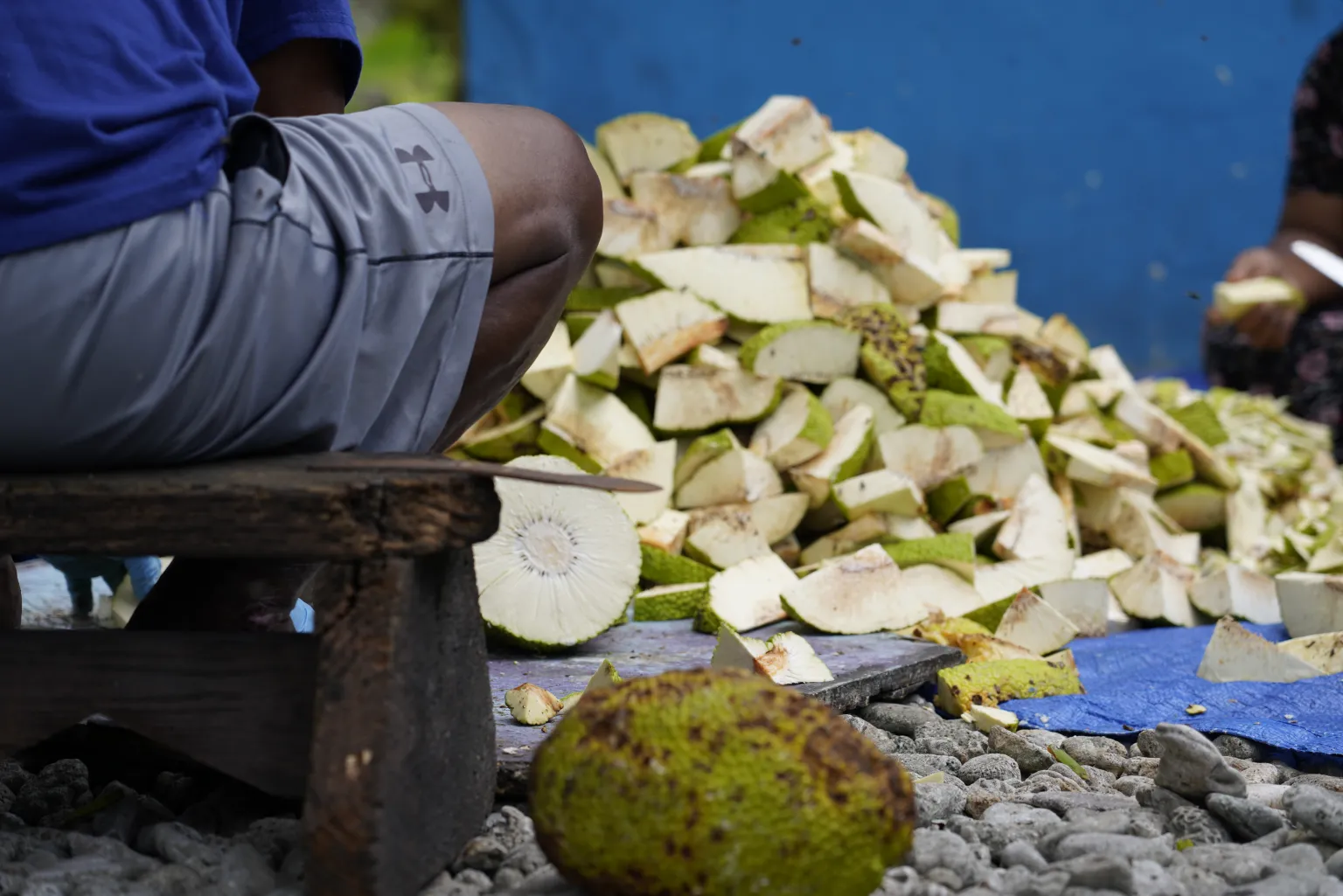
Breadfruit production is growing in just about every way in Hawaiʻi, as more farmers plant more trees that are producing more fruit.
The canoe crop, known as ʻulu, has experienced a renaissance for over a decade as Hawaiʻi residents have readopted the starchy staple. The cannonball-sized fruit has made it onto restaurant menus, public school meals and even into pancake mixes, flours and other ready-to-eat products.
Supply has responded to demand, increasing by an average of 34% every year since 2017. That’s 212,000 pounds of ʻulu produced throughout the past fiscal year —13 times more than the Hawaiʻi ‘Ulu Cooperative’s production a decade ago, according to numbers from the cooperative and the Department of Agriculture and Biosecurity.
This year’s devastating storms, associated with a potentially record-breaking El Niño, may result in a downturn as trees struggle. Still, the cooperative’s production is forecast to double by 2029 and more than quadruple by 2033, CEO Dana Shapiro said, as more of the members’ trees reach maturity, more trees are planted and more farmers get involved.
The ʻulu cooperative’s membership has grown from 12 producers to 227 since 2017, with 50 added in the last year. Those members currently look after almost 10,000 trees.
“Of that, about 60% are not what we would consider mature trees,” Shapiro said. “They’re still coming online.”
Currently, given the varying ages of members’ trees, the average annual production is 21.6 pounds per tree. It can take about 10 years for ʻulu trees to reach maturity. Trees of the maʻafala variety of ʻulu produce 250 to 450 pounds of fruit annually.
Even without planting more trees, Shapiro expects more fruit will be produced.
But turbulent weather has winnowed much of this year’s crop at the height of harvest season, which can run from July to December. The Kona low storms in March and Lala in August had an adverse effect on trees, forcing them to drop developing fruit early, said Noa Kekuewa Lincoln, who runs the Indigenous Cropping Systems Laboratory at the University of Hawaiʻi.
“Whether that’s the wind, or the tree stress or the flooding, clearly the storm systems have had a strong impact on the tree production,” Lincoln said. “I think we are going to see a dip this year… and we’re not even halfway through hurricane season.