Ocean & BiodiversitySeptember 10, 2026 Elders, Conservationists Race to Record Fading Sacred Ties to Philippines’ Endemic Birds
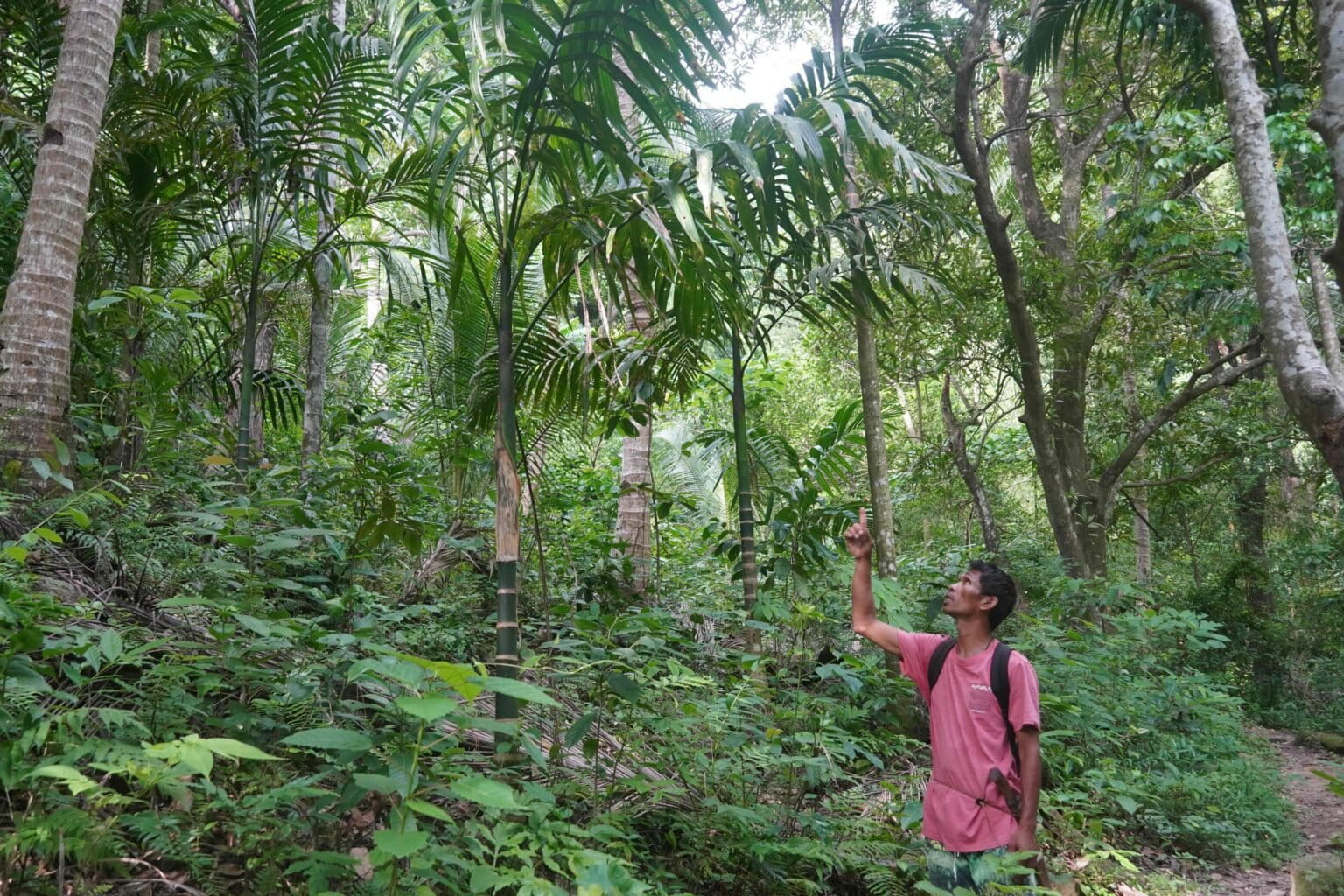
The forest settles into a gentle rhythm as the trail climbs into the Iraya Mangyan ancestral domain in Puerto Galera town, on the Philippines’ Mindoro Island.
Only birdsong breaks the silence as towering trees sway overhead. A clear stream tumbles across the trail over smooth rocks.
Ahead walks 43-year-old Lenito Pampilo.
Every few steps, he stops — not because the climb is difficult, but because the forest is speaking, he says. He points to an unseen bird in the canopy. Another answers from farther uphill. For him, each call carries meaning.
“Our elders taught us these birds,” he tells Mongabay.
Pampilo, an Iraya community leader and ecotrail guide, has spent much of his life in these mountains. His knowledge goes beyond recognizing species. “Some birds signal changing weather, warn of danger or carry messages between the living and spirit worlds,” he says. “Trees, streams and ridges also hold stories passed from one generation to the next.”
For the Iraya, the forest is a largely unwritten living archive.
As elders age and fewer young people learn beside them, the Center for Conservation Innovations Philippines (CCIPH) is helping Iraya knowledge holders document wildlife, medicinal plants and culturally important places under its Mindoro Forest and Biodiversity Conservation Programme (MFBCP), a REDD+ carbon finance initiative in eastern Mindoro Island.
This includes the UNESCO-designated Puerto Galera Biosphere Reserve, which overlaps with the Iraya Mangyan’s roughly 40,000-hectare (98,800-acre) ancestral domain, home to about 2,500 households, according to the CCIPH. The Iraya have used and managed its forests, settlements and culturally important places across generations.
The information will contribute to the Iraya’s Ancestral Domain Sustainable Development and Protection Plan (ADSDPP), and an ecotrail being co-developed with the community.
“The environmental information gathered from the community becomes part of their ADSDPP,” says Rey Luna, CCIPH project management adviser and former Oriental Mindoro provincial officer of the National Commission on Indigenous Peoples (NCIP). “From those data, the community can determine what projects are appropriate for their land.”
Luna says he envisions guides explaining why trees matter, how places were named and why some grounds are sacred.
“You’re not just walking through the forest — you learn the story of the place,” he says.
Where every bird tells a story
CCIPH surveys have recorded 517 species across the program area, including 134 animal and 154 plant species considered rare, threatened or endemic. These include 42 bird species, among them three culturally important endemics.
Pampilo began learning about birds as a child, when he and his friends playfully mimicked the siruk, or Mindoro boobook (Ninox mindorensis).
More birds answered until their calls surrounded the village. “The elders told us, ‘You’re teasing them,’” Pampilo recalls. “Then we all ran.”
Families spent the night elsewhere in the mountains, fearing malevolent spirits might pass through the settlement.
“We didn’t even bring our belongings,” Pampilo says. “We just left.”
Younger generations respond differently, he says, but the lesson remains: Do not provoke the bird. “We simply let it sing,” he says.
The sulit, or Mindoro scops owl (Otus mindorensis), carries another spiritual meaning. Some Iraya associate it with departed relatives, Pampilo says, and release any accidentally trapped bird.
For Pampilo, these customs teach restraint toward other forest beings.
The turis, or Mindoro racket-tail (Prioniturus mindorensis), provides practical guidance. Lenito’s cousin, Bernito Pampilo, an Iraya forest patroller recalls the parrots gathering noisily in one tree when he was about 9.
His father interpreted their behavior as a storm warning. That night, a powerful typhoon struck, forcing the family to shelter beneath the buttress roots of a large tree as their house was damaged.
“When I see them gather like that, I prepare,” Bernito tells Mongabay.
Such observations guided travel, farming and storm preparations before forecasts reached mountain communities.
Today, Christianity has also become part of Iraya religious life. Pampilo, who also volunteers in Catholic catechism for children, says Christianity has not entirely displaced Iraya spiritual traditions. He describes the two as coexisting.
“We now combine our beliefs with Catholicism, but not all our traditions have disappeared,” he says. “We keep what is most important to us.”
All three bird species are endemic to Mindoro and are declining due to deforestation and infrastructure development. The IUCN Red List classifies the Mindoro boobook and Mindoro racket-tail as vulnerable and the Mindoro scops owl as near threatened.
Currently, CCIPH-supported Indigenous patrollers monitor forests and report logging, hunting and other threats, while government personnel inspect ports and municipal borders for trafficked wildlife. The local government also conducts annual terrestrial biodiversity assessments, supplemented by CCIPH monitoring and targeted surveys of threatened and Mindoro-endemic species.
Ronet Santos, a bird photographer and senior program operations manager of the D’Aboville Foundation, a nonprofit environmental organization working in Mindoro, says the three birds also indicate forest health. The Mindoro racket-tail helps disperse seeds while the Mindoro boobook and Mindoro scops owl provide natural pest control by keeping prey populations in check.
“Long-term Indigenous observations can complement scientific knowledge and conservation initiatives by providing a complete temporal picture of these species’ behavior,” Santos tells Mongabay. “It’s not easy for scientists to observe species over the long term, and when they do, they need local Indigenous guides. Indigenous peoples are in the area throughout the year, while scientists only ‘bungee jump’ into the area for short periods.”
Santos adds that many of Mindoro’s remaining endemic species occur within Indigenous ancestral domains, making community collaboration vital for long-term monitoring. In the foundation’s tamaraw (Bubalus mindorensis) work, Indigenous observations have helped researchers assess age classes and reproduction.