
Content Library

News

Curated stories and analysis from islands and sustainability leaders worldwide.

Showing 9 of 2022 news items
Green tribunal rules in favour of Great Nicobar Island project, citing ‘adequate safeguards’
Ocean & BiodiversityFebruary 25, 2026

Green tribunal rules in favour of Great Nicobar Island project, citing ‘adequate safeguards’

Excerpt from india.mongabay.com The National Green Tribunal (NGT) has refused to interfere with the environmental clearance for the Great Nicobar Island project, concluding that “adequate safeguards have been provided” for gaps in the clearance process. The order follows a lengthy court battle challenging the project’s compliance with coastal regulations, which prohibit the development of large projects in sensitive coastal areas. The NGT pronounced its order on February 16, after reserving its judgement for several months. The development of Great Nicobar Island has drawn sharp criticism from environmentalists, sociologists, and members of the Opposition for the destruction it will cause on the island, which is part of the Andaman and Nicobar Islands. The ₹81,000 crore (₹810 billion) project includes building an international container trans-shipment port on a leatherback turtle nesting site, as well as an airport, gas and solar power plant, and township which will lead to the felling of a million trees. The government argues that the project will help India take advantage of trade routes along the Malacca strait, which would “counter the pressure being built by foreign powers’ growing presence.” In its order, the NGT said that “considering the strategic important of the Project [sic],” it found no “good ground” to interfere with the project’s environmental clearance, which was granted in 2022. Jairam Ramesh, former environment Minister and a vocal critic of the project, called the outcome “deeply disappointing,” in a post on X. “There is clear evidence that the project will have disastrous ecological impacts. The conditions for its clearance, that the NGT draws reference to, will do little to deal with these long-term consequences.”

Read more
Elia Seeks Contractor to Build Onshore Infrastructure on World’s First Artificial Energy Island
Energy & TransportFebruary 25, 2026

Elia Seeks Contractor to Build Onshore Infrastructure on World’s First Artificial Energy Island

Excerpt from offshorewind.biz The TSO is looking for a contractor carry out the works required to host AC and related infrastructure on Princess Elisabeth Island (PEI) in the Belgian exclusive economic zone (EEZ) in the North Sea. The scope includes detailed engineering and design, procurement, construction, and installation on the island’s land area, as well as the transport and accommodation of personnel offshore, and the transport of all necessary materials and equipment offshore. The deadline for submitting requests to participate in the tender is set for 3 April, with the construction work expected to take two years. Developed by Elia Group, the island is being built by TM Edison, a consortium including DEME and Jan De Nul, which installed the first batch of the island’s concrete substructures in 2025, with the campaign completed in October last year. The installation of the caissons will resume this spring, alongside continued works to prepare the island’s interior, according to Jan De Nul, which recently completed construction of the remaining concrete structures for the Princess Elisabeth Energy Island at the Vlissingen site in the Netherlands.

Read more
When Climate Extremes Don’t Lead to Conflict: Evidence from the Pacific Islands
Climate ActionFebruary 25, 2026

When Climate Extremes Don’t Lead to Conflict: Evidence from the Pacific Islands

Photo Credit and Excerpt from newsecuritybeat.org Pacific Island countries sit at the frontline of climate change. Many consist of small, low-lying islands, with long coastlines and vast ocean spaces between them. Livelihoods often depend on agriculture and fishing, and importing water or food is often infeasible or expensive. This makes those large ocean nations highly vulnerable to the impacts of climate change, such as storms, droughts, and rising sea levels. Given these vulnerabilities, analysts have expressed concerns that climate change could heighten various forms of socio-political conflict in the region. Yet the Pacific Island countries have received scarce attention in research on climate change and conflict. While recent scholarship has begun to explore possible pathways between climate stress and conflict in the Pacific Island countries, the region remains comparatively understudied. This is especially surprising given the regions’ high climate vulnerability and increasing geopolitical relevance.

Read more
Guam calls for moratorium on seabed mining, sees growing opposition against seabed raid
Ocean & BiodiversityFebruary 18, 2026

Guam calls for moratorium on seabed mining, sees growing opposition against seabed raid

Excerpt from pacificislandtimes.com Any adverse impacts from leasing the Northern Mariana Islands' outer continental shelf for seabed mining will likely affect a wider area, including Guam, according to the Bureau of Statistics and Plans. Lola Leon Guerrero, the bureau's director, noted that the proposed mining site, as outlined by the Department of the Interior’s Bureau of Ocean Energy Management, is only about 128 nautical miles from Guam, near enough so that any negative impacts will likely disturb the territory. “Such an impact could pose a significant threat to the biodiversity of the Mariana Trench and the surrounding seamounts, which are globally recognized hotspots, and could consequently compromise the ecosystem function within Guam's exclusive economic zone,” Leon Guerrero said in her written testimony read by Edwin Reyes, BSP administrator, at a public hearing on Wednesday.

Read more
More than 5 years after Wakashio oil spill, questions linger in Mauritius
Ocean & BiodiversityFebruary 18, 2026

More than 5 years after Wakashio oil spill, questions linger in Mauritius

Excerpt from news.mongabay.com In August 2020, Vikash Tatayah at the Mauritian Wildlife Foundation made a phone call he never expected to make. He had “an unusual request,” he recounts telling friends in the U.K. who owned a private jet: A bunch of geckos needed to be evacuated. Mauritius had just entered COVID-19 lockdown, its airspace was closed, so it would have to be a special flight. Amid the chaos of the pandemic, the island nation had been hit by one of the worst environmental disasters in its history. On July 25, the MV Wakashio crashed onto coral reefs off Mauritius’ southeastern coast, later spilling around 1,000 metric tons of oil.

Read more
Beyond health: Pacific islands cast a wider net to strengthen health security
Policy & GovernanceFebruary 18, 2026

Beyond health: Pacific islands cast a wider net to strengthen health security

Excerpt from who.int Given that more than half of the infectious diseases affecting people originate in animals, the next public health emergency may not begin in a hospital or clinic but at a farm or in a flooded community. Across Pacific island countries and areas, climate-sensitive diseases further intensify these challenges. Leptospirosis, for example, often rises after heavy rainfall and floods, while food and water safety remain a major concern with unsafe food linked to more than 200 diseases worldwide, many of them present in the Pacific. While these risks are already well known, findings using the tools under the International Health Regulations (IHR) clearly show that preventing and controlling diseases transmitted from animals to humans remains an urgent priority. The IHR – which came into effect in 2005 and were recently amended to strengthen them further – are a legally binding framework adopted by 196 WHO States Parties, including Pacific island countries, to prevent, detect and respond to public health threats with the potential of international spread. The need for urgent action was discussed at a recent meeting of Pacific islands from 3 to 5 February, where, for the first time, more than 70 participants came together representing not only national IHR focal points but also the animal health and legal sectors.

Read more
Maldives launches process for gender-based climate policy
Policy & GovernanceFebruary 18, 2026

Maldives launches process for gender-based climate policy

Excerpt from muslimnetwork.tv Maldives has taken a first formal step toward integrating gender equity into its climate policy framework, launching a national workshop to begin work on the country’s inaugural Climate Change Gender Action Plan (CC-GAP). The inception workshop, held earlier this week, brought together government institutions, academic bodies, civil society groups and international partners, signalling a coordinated push to embed gender considerations into climate adaptation and mitigation strategies. The initiative is being led by the Ministry of Tourism and Environment in coordination with the Ministry of Social and Family Development, reflecting growing recognition that climate impacts in island nations are not gender-neutral. Officials said the planned framework aims to address how climate risks intersect with livelihoods, health, disaster preparedness and access to economic opportunities.

Read more
On Indonesia’s longest river, a Borneo community passes crucial public health milestone
Culture & CommunityFebruary 18, 2026

On Indonesia’s longest river, a Borneo community passes crucial public health milestone

Excerpt from news.mongabay.com SEKADAU, Indonesia — Children’s laughter skimmed over water the color of mud as mothers wrung laundry over banks where the Sekadau joins the Kapuas, the longest river in Indonesia. Local testimony along the Kapuas River, which flows 1,143 kilometers (710 miles) east to west from Borneo’s Müller Mountains out into the Natuna Sea, suggests this river — like many flowing across the world’s largest archipelagic country — may be losing prominence as a center of community life. “The river is dirtier now and no longer a gathering place like before,” an older resident told researchers from Tanjungpura University downriver in Pontianak, the capital of West Kalimantan province, for a study published in September. But here in Sekadau, the river remains central to daily life — a place to bathe, wash vegetables, and, until recently, to defecate. Research conducted on the Kapuas from 2020-2022 and published in the Journal of Aquaculture and Fish Health last year recorded double the legal limit of lead, a heavy metal pollutant that impairs neurological development — and 24 times the maximum coliform bacteria level for rivers permitted by Indonesia’s government.

Read more
Trump’s Greenland threats put crucial climate change research at risk
Policy & GovernanceFebruary 18, 2026

Trump’s Greenland threats put crucial climate change research at risk

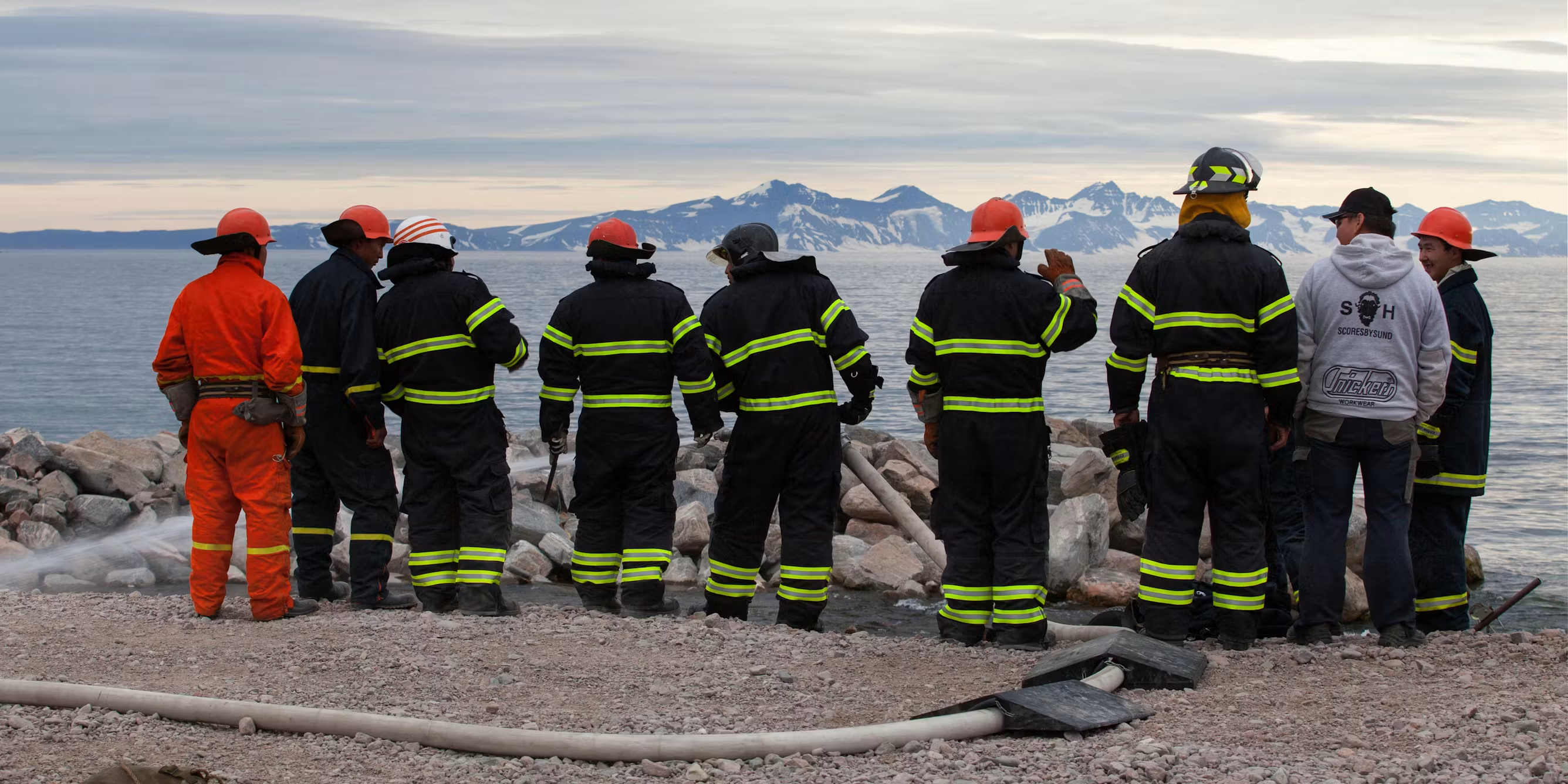
Excerpt from japantimes.co.jp U.S. President Donald Trump’s vows to take over Greenland have chilled relationships between American and Greenlandic researchers, halting some projects and making future collaborations uncertain. Ross Virginia, a professor emeritus of environmental studies at Dartmouth College, said a climate program he ran with Greenlandic colleagues was halted by “mutual agreement” due to the tensions. “Direct cooperation is paused while we determine what a future vision for collaborative science diplomacy — particularly involving education and younger students — could look like,” he said. Another U.S. scientist, who asked not to be identified for fear of jeopardizing relationships, said some of his research partnerships in Greenland were paused even before Trump escalated talk of annexation in early January, and that he suspended fieldwork out of respect for Greenlanders.

Read more