A Robot Swarm Is On a Mission to Map Greenland’s Perilous Ice Sheets
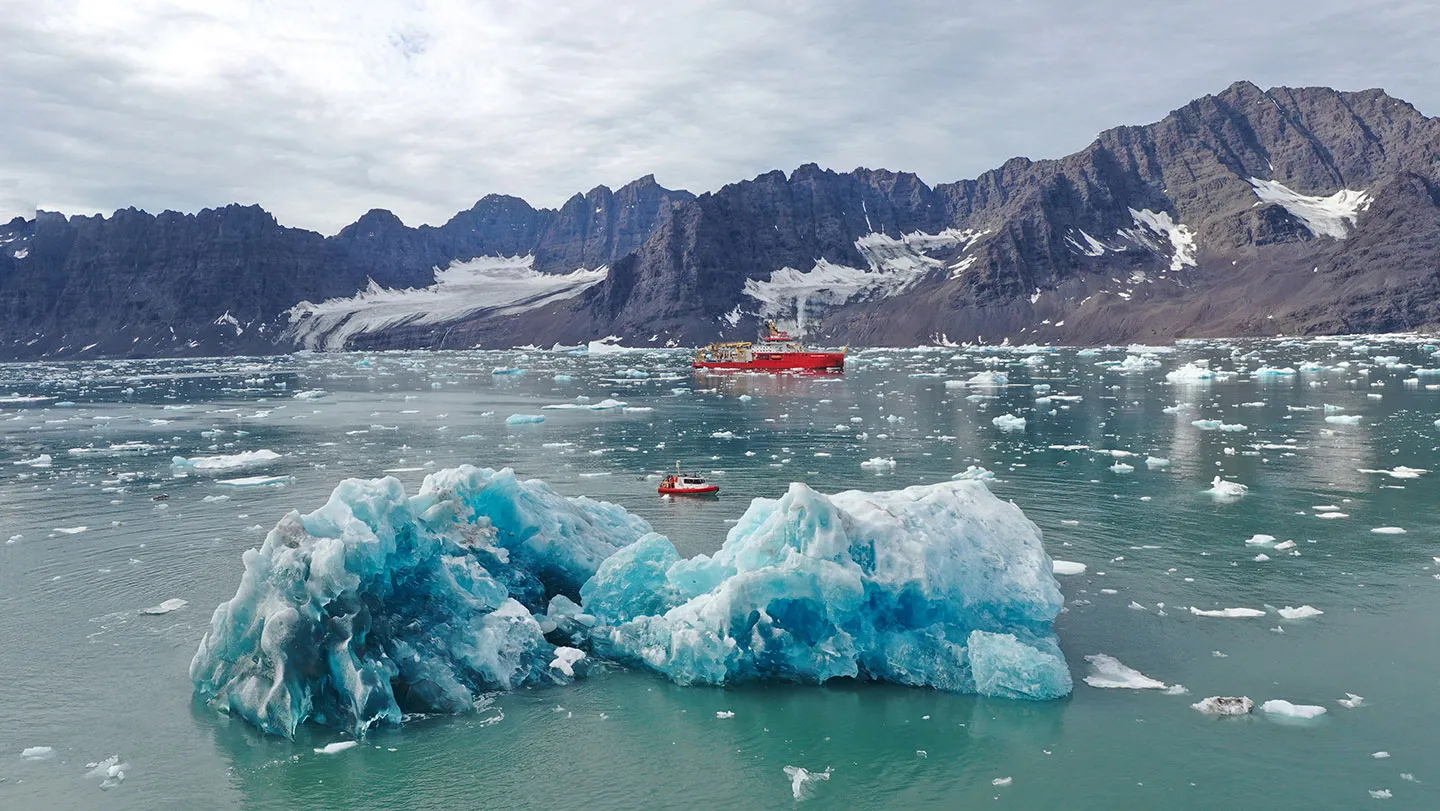
This summer, in remote Greenland, a suite of high-tech gadgets and robots will be deployed, James Bond–like, at the treacherous points where glaciers meet the sea. Their mission: Study melting ice in never-before-seen detail. The data from the expedition, funded by the British government’s secretive new inventions agency, will feed into the latest climate models. The idea is to forecast when the ice melt will tip climate-regulating ocean currents into a shutdown, and try to develop an early warning system that would let humanity know when glaciers are changing in an alarming way. The voyage, launching on July 16, “addresses a foundational data deficit in one of the most consequential parts of the climate system,” says sea ice acoustics expert Hari Vishnu of the National University of Singapore, who isn’t involved in the work. “We cannot model what we cannot observe.” Until recently, such a mission would have been impossible. Where Greenland’s glaciers meet turbulent waters, “ice cliffs tower above the ocean surface — sometimes 30 meters high, sometimes a hundred — fracturing, collapsing and launching house-sized icebergs into the fjord with little warning,” says oceanographer Jonathan Nash of Oregon State University in Corvallis. Nash is a member of the project, which is named GIANT, for Greenland Ice sheet to AtlaNtic Tipping points from ice loss. Under the sea surface, Nash says, chaotic plumes and eddies rise and swirl. It’s difficult and dangerous for scientists to get instruments close enough to the key area of interest: the centimeters-thin boundary layer where ice meets ocean. The danger element, combined with the challenges and scale of collecting lots of different types of data from above, on and below ice all at once meant previous projects could work on only one aspect of the problem at a time, if at all. “We always wanted to create a project that could simultaneously observe and model all parts of this process,” says Paul Holland, an ice scientist at the British Antarctic Survey in Cambridge, England. So, when Holland and his colleagues saw a call for grant proposals from the U.K. government’s recently launched Advanced Research and Invention Agency, which backs high-risk projects, they jumped at it. The 20 million British pounds ($26 million) in funding comes at a time when uncrewed technology is becoming sophisticated enough to eavesdrop on ice at close range, traversing perilous waters and crumbling ice rocks without endangering researchers. “We’re in a moment where our tools have finally caught up with our questions,” says marine geophysicist Kelly Hogan of the British Antarctic Survey. “We can explore glacier-ocean interactions in ways that were unimaginable just a few years ago.” Climate models don’t account for intricacies of ice melt As Earth warms, Greenland is already losing several times more ice than it did just few decades ago. If enough freshwater from melting ice enters the ocean, it could topple vital ocean currents. One, the Atlantic Meridional Overturning Circulation, or AMOC, transports warm tropical waters northward before cooling, sinking and returning southward. An interruption of AMOC would make Europe colder and drier, and would also dramatically shift tropical monsoons, affecting agriculture and the food supply. “If the AMOC is a pot of warm, salty soup that’s flavored just right, then it’s like adding cold tap water to the pot. The Greenland icebergs ruin the soup,” says earth scientist Kristin Poinar of the University at Buffalo in New York, who is not involved with the expedition. “The AMOC relies on dense, salty ocean water to sink, and too much freshwater from icebergs will slow or stop that process.” Multiple lines of evidence suggest that the AMOC is already weakening. The actual shutdown of the current, and its impacts, would play out over decades or centuries, though there is still a lot of uncertainty. That’s in part because climate models have so far treated ice melt as a simple process — warm water arrives, heat is transferred and ice melts. They don’t account for the physical complexity of the environment where huge glaciers meet choppy seas. One such nuance is the tiny bubbles of ancient air trapped in glacier ice that are freed during melting and then rise along the ice face. They may intensify the mixing of the ice-ocean layer and drive more heat transfer. But they’ve been impossible to observe and thus to add to existing models. Though the bubbles are small, Nash says, they could have “considerable” implications for sea-level rise projections when multiplied across hundreds of glaciers. Heat transfer by such bubbles may also be one of the myriad similarly small but important drivers in iceberg calving events — when chunks of ice break off at the edge of a glacier or ice shelf and fall into the sea. Glaciers shed many icebergs into the ocean during some years and fewer in others, a phenomenon the mission’s data should help explain, Poinar says. The expedition’s planned millimeter-scale observations of phenomena such as bubbles, she says, will be “like watching a crack form in a windshield before it shatters.” The observations will feed into a climate model called the U.K. Earth System Model. It “is already a very good climate model, and it’s about to get even better,” Poinar says. The voyage “will give it an immediate upgrade, driven by brand new data from some of the most data-scarce places on Earth.” A flotilla of robots will fill in the details The mission will deploy a fleet of submarines, robots, drones and sensors from a mothership, the Royal Research Ship Sir David Attenborough, which itself is a floating laboratory. The vessel will spend much of July and August near the steep fjord glaciers of Kangerlussuaq in southeast Greenland. Next summer, measurements will take place at the Petermann glacier in Greenland’s northwest. Many of the robots are being tested in the field and tweaked on an ongoing basis to make them work as hoped, Holland says, so “reality is perhaps more experimental than you would see in [James Bond] films.” The ship will release rugged flying drones to study ice from above, at a closer range than the satellite data the team already gets. The drones are engineered to stay airborne when the weather turns hostile or when ground access collapses. The vessel’s helicopter will drop small sensors to measure changes on the surface of glaciers, terrain that is naturally booby-trapped with crevasses and ice streams. The sensors are essentially a GPS in a javelin. The javelins embed into the ice on one end and track the ice movement as the glacier melts, all while transmitting data to researchers from the antenna on the end that sits above the ice.